
News and analysis · City Hall
B.C. turns Conservative. What happens to homes and transit in Vancouver?
B.C.'s preliminary election result, Vancouver's riding leads and what the incoming government could change for housing and transit.
Share this article
Lorne Doerkson's Conservatives are set to form a majority government after B.C.'s October 24 election. Here at Side Street, we're thinking about what that means for the apartment near the bus stop, the shop downstairs and the trip across town that takes longer than it should.
The new government will have a say in all three. Its promises include more local control over housing, faster approvals and SkyTrain to Newton. We want to know whether those promises will make it easier to find a home and get around without a car.
CityNews projected a Conservative majority on election night. David Eby subsequently announced that he would resign as NDP leader. The change puts a different provincial government across the table from Vancouver's newly elected mayor, Pete Fry. CityNews election coverage · Eby's announcement, reported by CityNews.
The result so far
| Party | Ridings leading | Vote share counted |
|---|---|---|
| Conservatives | 63 | 48.06% |
| NDP | 28 | 37.37% |
| Greens | 2 | 10.97% |
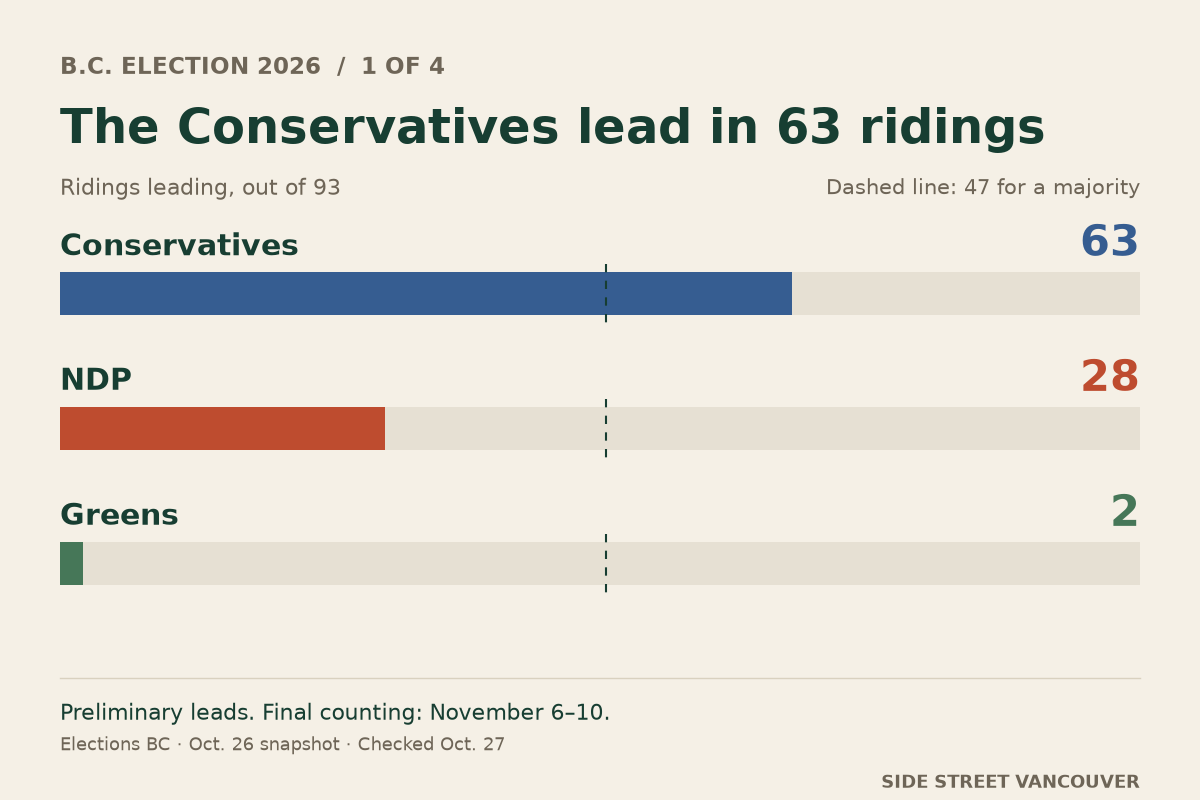
Source: Elections BC, checked October 27. These are the latest available preliminary results. Final counting runs November 6–10, including mail-in and absentee ballots. The table shows the three parties leading in ridings.
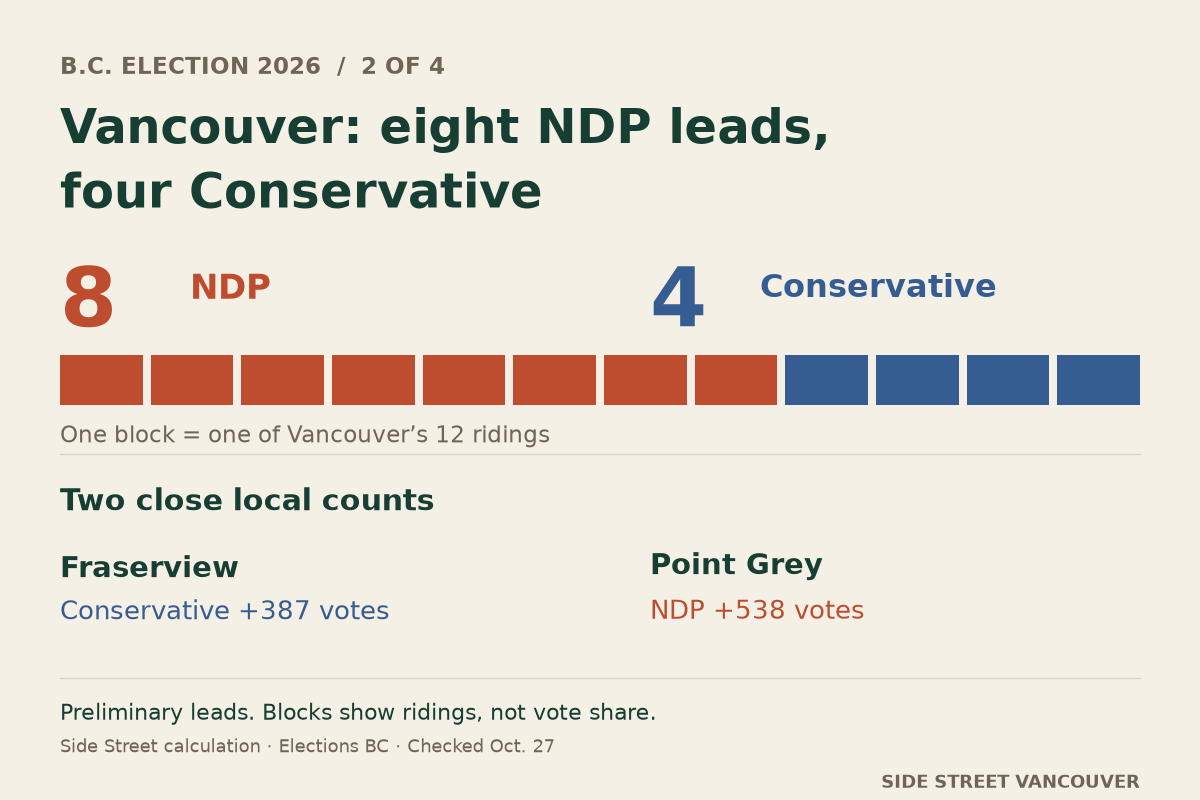
Our tally of the 12 Vancouver ridings gives the NDP eight leads and the Conservatives four: Fraserview, Langara, Quilchena and Yaletown. Two local races merit another look at final count. The Conservative lead in Fraserview is 387 votes; the NDP lead in Point Grey is 538. Those margins are our subtraction of the two leading parties' totals in Elections BC's table.
See all 12 Vancouver riding leads
| Riding | Leading party | Votes ahead |
|---|---|---|
| Fraserview | Conservative | 387 |
| Hastings | NDP | 4,912 |
| Kensington | NDP | 1,679 |
| Langara | Conservative | 1,650 |
| Little Mountain | NDP | 3,070 |
| Point Grey | NDP | 538 |
| Quilchena | Conservative | 5,687 |
| Renfrew | NDP | 3,299 |
| South Granville | NDP | 3,938 |
| Strathcona | NDP | 4,499 |
| West End | NDP | 3,546 |
| Yaletown | Conservative | 844 |
Vancouver's municipal result is already official. Fry will sit with four Green, four COPE, one OneCity and one ABC councillor. No party has a majority by itself. City declaration, October 21.
That leaves a new mayor and a new provincial government needing to work together. A bus doesn't stop at a municipal boundary, and the need for homes doesn't either.
The housing question is about permission to build
The Conservatives' 2026 platform promises faster approvals, lower construction charges and more municipal control over where density goes, through local official community plans with density targets. Its housing section does not set out a specific Bill 47 repeal or explain which provincial minimums would remain. Platform, printed pages 5–6.
The Union of B.C. Municipalities identifies repealing Bill 44 among the Conservatives' commitments in its October 26 response to the result. That is a commitment to watch, rather than a change already in force. Bill 47 is a separate law. UBCM's response.
B.C.'s recent housing changes cover several different decisions:
| Policy | The practical distinction |
|---|---|
| Small-scale housing rules, associated with Bill 44 | More homes on qualifying residential lots, with conditions and exemptions |
| Transit-oriented housing rules, associated with Bill 47 | Greater housing capacity near designated stations and exchanges |
| Provincial housing targets | Measurement of net new completed homes, rather than simply approvals |
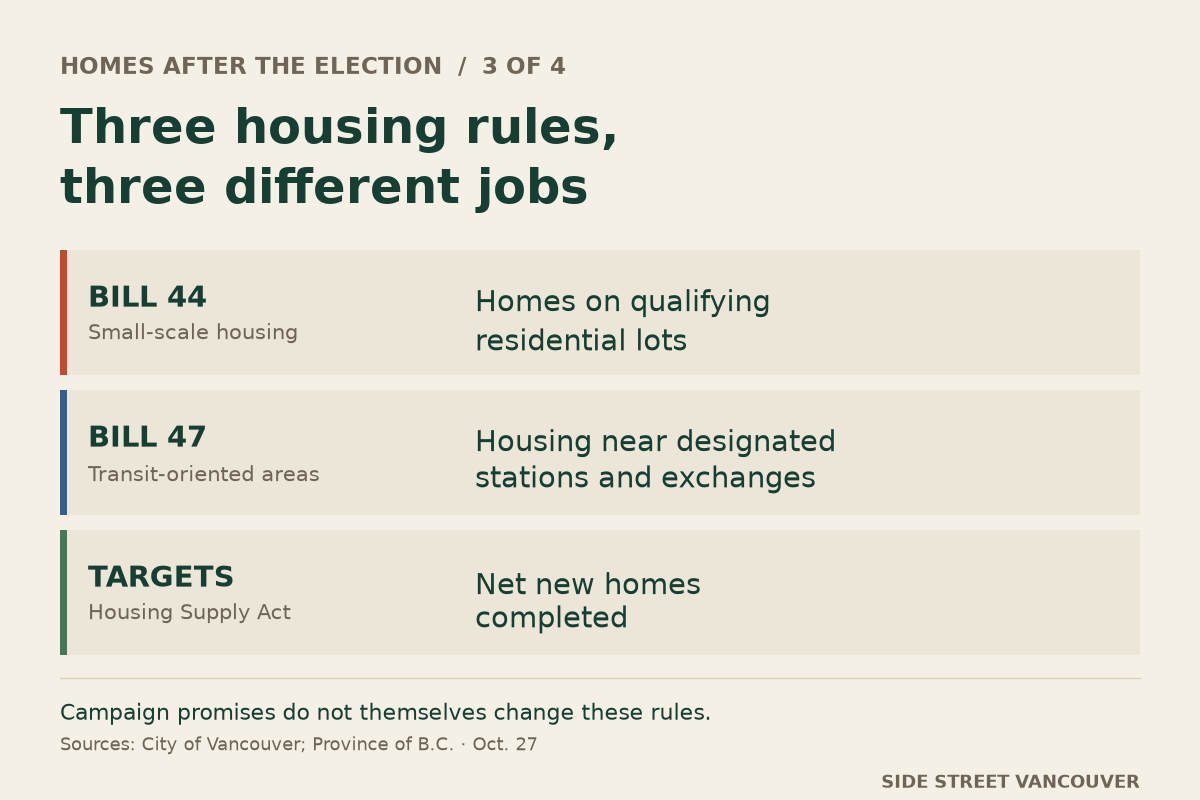
Sources: Vancouver's implementation of the housing rules and the Province's housing-target progress report.
Vancouver made its own changes too. In June 2024, the City removed minimum car-parking requirements citywide, going beyond the provincial requirements. Those local decisions still matter. An election result doesn't rewrite a zoning bylaw overnight.
Our view: keep a provincial minimum. There should be room for more neighbours near a useful bus or SkyTrain station, even when a council would rather leave things as they are. We'd like more homes above shops, more front doors on quiet streets and fewer people priced out of the neighbourhoods they know. Tenant protection and the details of each building deserve care, too.
Faster approvals would help. So would lower rents. We'll judge the new government's housing plans by whether they make those things more likely, and whether a replacement for today's rules still leaves enough room to build.
A SkyTrain promise, and the bus people need sooner
Doerkson's October 20 announcement committed to working with Ottawa to fund and build SkyTrain to Newton along King George Boulevard. It supplied no full project budget or opening date. Conservative announcement.
TransLink already has a bus rapid transit proposal for that street, extending beyond Newton toward South Surrey. It describes 19 kilometres, 12 stations and service every five minutes at peak times. The program has preliminary funding, but needs more to deliver the projects. TransLink's BRT program.
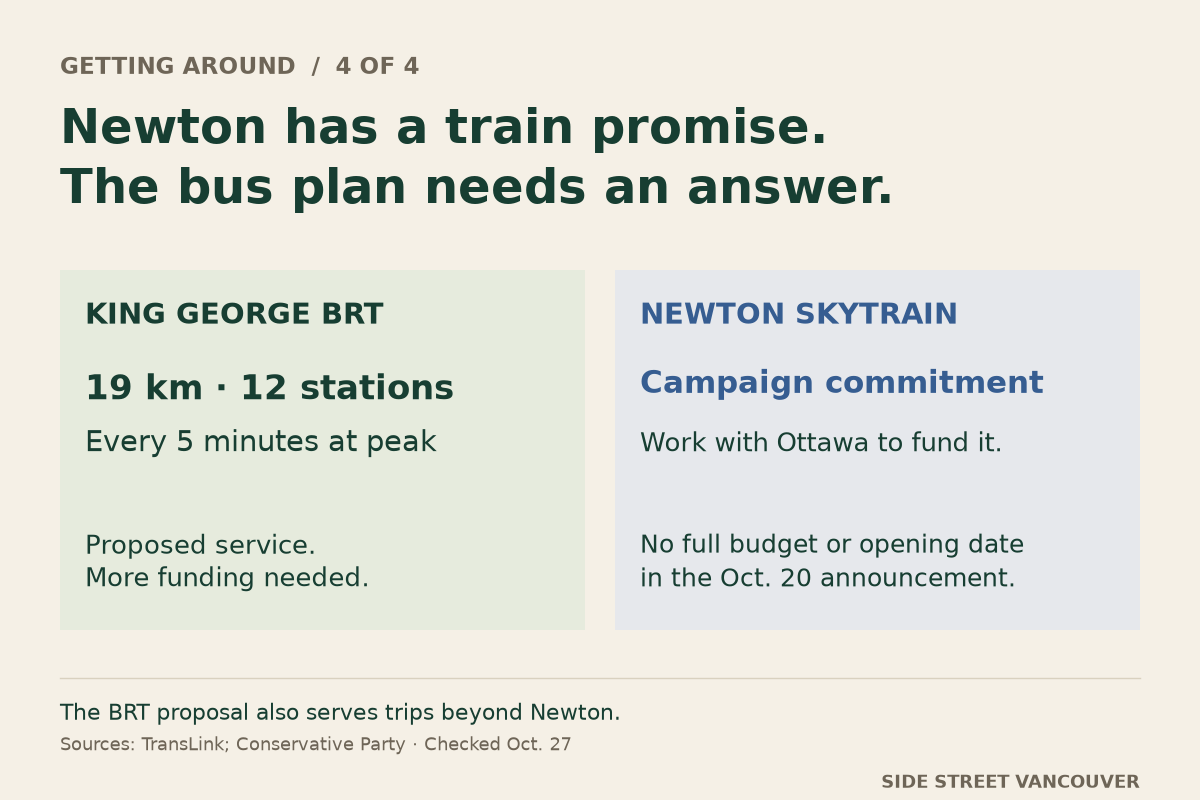
We'd welcome a useful train connection to Newton. We'd also like the person waiting for a bus on King George to get something sooner. Dedicated lanes and frequent service need funding and dates of their own, including for the route beyond Newton.
The Conservative platform also pledges to prevent TransLink from taxing car ownership or registration. If that funding option goes, the incoming government owes riders an answer about what pays for more service. People planning their day around a bus timetable need to know whether the next bus will come more often. Platform, printed page 5.
What we will follow from here
The Conservatives named Kim Henderson to chair their transition team on October 25. Next come cabinet appointments and the first decisions on housing and transport. We'll be looking for the details that turn a promise into something a neighbourhood can use. Transition announcement.
In Vancouver, voters approved $790 million in borrowing authority, including $292 million for transportation and streets. That gives the incoming council decisions to make about delivery. We'll follow what reaches a budget and then a street: the bus lane, the crossing, the route to a neighbourhood shop. Council's inauguration is November 2. Official municipal results.
Our story on the former Point Grey Safeway site is a good place to start: proposed rental homes, a grocery store and walking routes through the block. That's the scale we keep coming back to. A change in Victoria matters here when it makes room for a neighbour, improves the bus ride or gives you one more reason to walk to the next block.
Vancouver election guide · Try the Vancouver election compass · Standards and corrections
