
Practical guide · City Hall
How to use our Vancouver election compass
Advance voting has begun. Start with your own views, compare the replies, and follow the questions that matter to you through our profiles and election coverage.
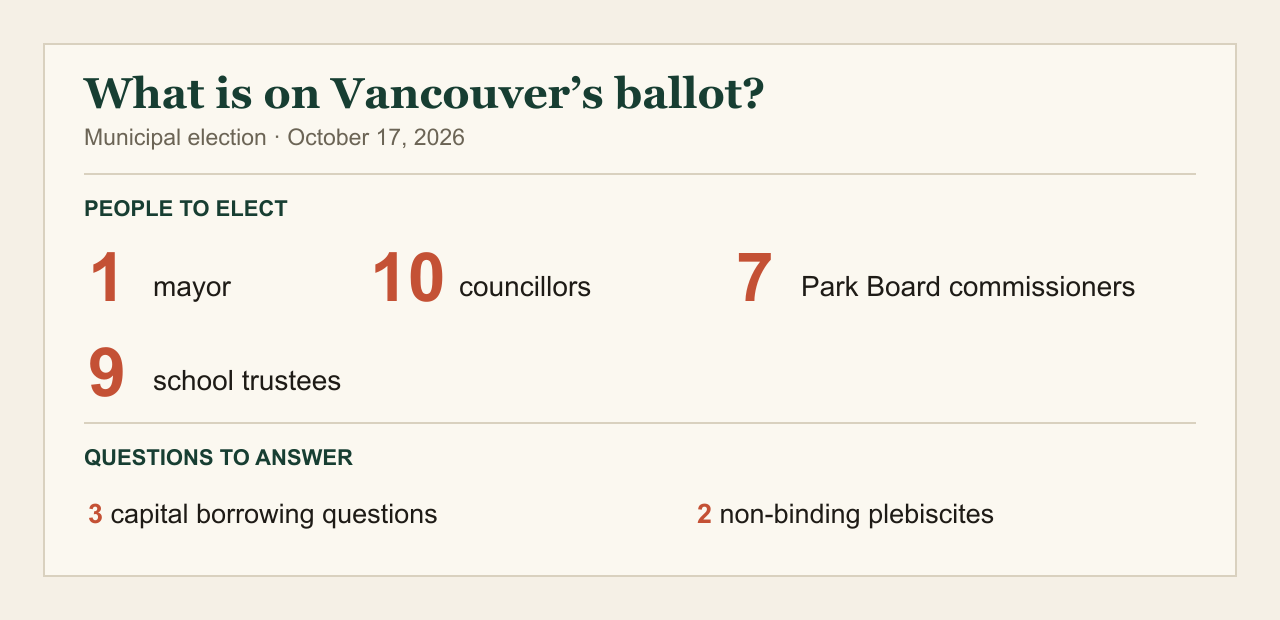
Vancouver's advance voting begins October 3. If you're getting ready to vote, our election compass can help you work through the local policy choices and compare your answers with candidates and parties.
There are plenty of campaign promises to read this election. Working out where you stand on the choices behind them takes a little longer. Should Vancouver make more room for apartments? Give buses their own lanes? Freeze the general property-tax levy, or raise taxes to protect services?
Our Vancouver election compass puts 16 local policy statements in front of you. Answer them, then compare your choices with the available party and candidate replies. You can skip a question or say you're not sure. No signup is required.
Start with your own answers. It is useful to decide what you think about a statement before seeing the names beside it.
Look at the questions you care about
The results give you several ways into the comparison. The housing chart covers permission to build homes and municipal support for housing. Other subjects, including bus lanes, policing and taxes, appear in the comparisons beside it.
Open the individual answers, especially on the issues that matter most to you. The percentages summarise agreement on the questions covered. They do not measure every part of a platform, and parties with different amounts of evidence cannot fairly be ranked by those numbers alone.
Direct party replies are labelled separately from personal candidate replies. Some other party positions come from published sources, with the source and reasoning available to read. A missing answer does not count as a neutral position.
The explanations can change what agreement means
Our published questionnaire results currently include eight personal candidate replies and four separate party replies. They give you a chance to read the same question across several campaigns.
All twelve respondents support allowing more low-rise apartments in residential neighbourhoods. Their explanations take that agreement in different directions. Andy Lin points to main roads and intersections, Devyani Singh calls for tenant protections, and Steve Jedreicich emphasizes public consultation.
The four party replies divide evenly over a freeze of the City's general property-tax levy in 2027. ABC Vancouver and TrueBlue Vancouver strongly support it. OneCity Vancouver strongly opposes it, and Vote Vancouver opposes it. Those pairings change on other questions: ABC strongly supports funding additional police positions, while TrueBlue strongly opposes it.
That is a useful reason to read across issues. Sharing one answer does not mean sharing a programme for the city.
Keep reading beyond the compass
Use the compass to guide your reading through the election season and to find questions worth asking candidates. It is a starting point for your decision, not a voting recommendation.
Our mayoral profiles and party guide bring together campaign priorities, background and source links. The election guide links to the wider coverage and practical voting information. You can also open any name on the full questionnaire page to read every selection and its complete explanation.
Take the Vancouver election compass.
Vancouver election guide · Try the Vancouver election compass · Standards and corrections