
Vancouver Election 2026 · Candidate questionnaire
Vancouver election questionnaire: common ground on apartments, a split over taxes
October 2 edition: Respondents received their recorded answers for an accuracy check today. That review period is still open. We will correct transcription errors promptly and date material changes. Send a correction.
Read the story, compare the shared answers, then open any candidate or party's full reply. 8 personal candidate replies and 4 party replies are included in this edition. Later replies will receive dated updates.

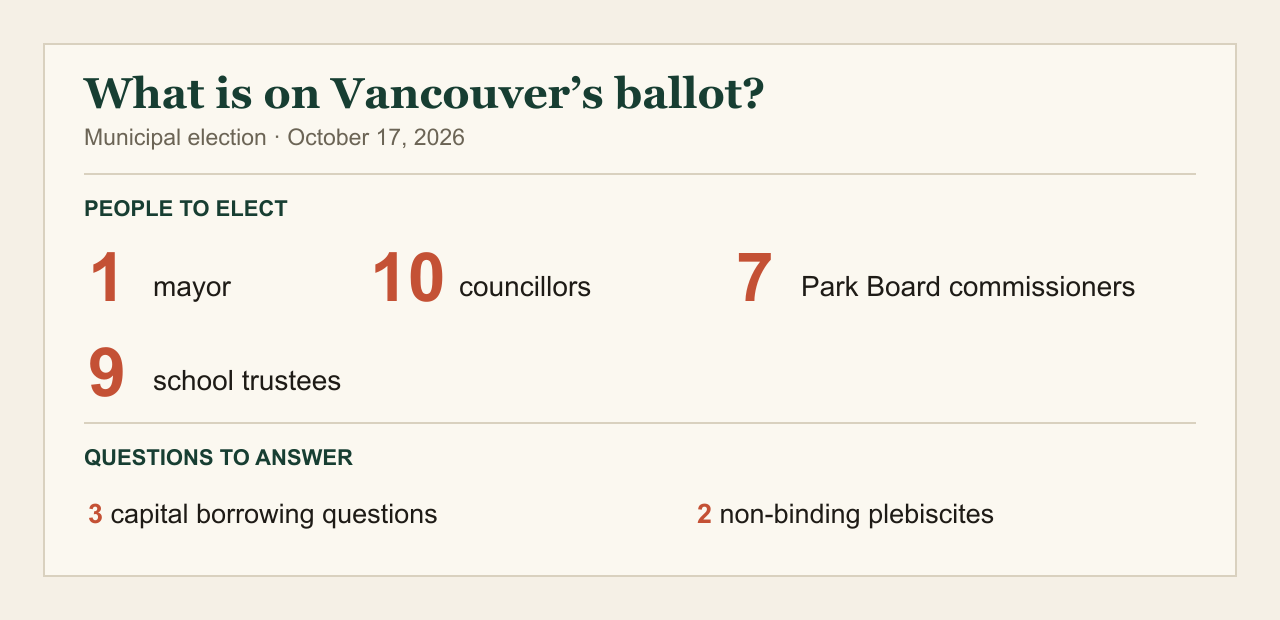
Should Vancouver allow more low-rise apartments in residential neighbourhoods? Every respondent included in this edition says yes. That sounds like common ground until the details arrive. One candidate favours six storeys near rapid transit. Another wants protections for existing tenants. A third stresses public consultation. Council will have to make those choices, not just agree with a general statement.
We asked the same 16 policy questions of mayoral and Council candidates. Eight candidates answered personally in this edition and four parties sent separate replies. Their selections reveal some useful patterns, but the explanations are where those patterns become interesting. Parris J. Williams's personal answers were added on October 2; his separate profile remains in review.
The parties do not fall into tidy camps
The four party replies split evenly on a proposed freeze of the City's general property-tax levy in 2027. ABC Vancouver and TrueBlue Vancouver strongly favour it. OneCity Vancouver strongly opposes it, and Vote Vancouver opposes it.
That pairing changes with the question. ABC and TrueBlue both favour stronger restrictions on public drug use, but ABC strongly supports funding additional police positions while TrueBlue strongly opposes it. OneCity strongly supports more City-owned homes, while Vote Vancouver gives a neutral answer. A shared tax position does not amount to a shared plan for housing or public safety.
Agreement on housing still leaves big choices
Among the personal candidate replies published today, support for more low-rise apartments comes with different conditions. Andy Lin points to main roads and intersections. Devyani Singh calls for tenant protections. Steve Jedreicich emphasizes public consultation. The selected answers line up; the plans behind them do not necessarily line up.
Other questions show clearer divides. Seven of the eight personal respondents support giving frequent buses dedicated lanes by reallocating general traffic lanes; Noi Soudarack disagrees. On funding more police positions, the choices range from agree to strongly disagree. Those differences deserve more than a label or a single overall score.
Use the compass, then follow the questions
Election season brings more claims than anyone can hold in their head. Take the 16-question election compass to see which choices matter most to you, compare your answers with available candidate replies and separately labelled party positions, and find questions worth following up. It is a guide for further reading, not a voting recommendation.
Then read the full questionnaire results, with every selection beside the respondent's complete explanation and the separate project and ballot questions. Our mayoral profiles and party guide add campaign priorities, background and source links beyond this questionnaire.
This is a comparison of the replies received, not a survey of the whole ballot. One mayoral candidate and seven Council candidates are included personally. A party response does not stand in for each candidate's personal view, and a missing reply tells us nothing about where someone stands. Later replies and corrections will be added with an update date.
Method: Respondents chose positions on the same 16 policy statements used in the compass and could explain their answers. Five project and plebiscite questions are displayed separately and do not affect compass comparisons. Skipped, undecided and declined answers are not scored as neutral positions. We sent each respondent their recorded answer text on 2 October and invited corrections. That review window remains open. If a transcription error is reported, we will correct it promptly and note the change here.
COMPARE THE REPLIES
One question, several answers
Everyone was asked the same 16 policy statements. A colour shows agreement or disagreement with the statement, not whether a position is better. Party replies remain separate from personal candidate replies.
Choose whose answers to see
Select any mix of candidates and parties. This table shows their exact selections; open a full reply below for the explanations.
4 replies selected
Agree Neutral Disagree Other or no answer
Choose at least one candidate or party to compare their selections.
| Policy question | Amauri CalimanMayor candidateFull reply ↓ | Andy LinCouncil candidateFull reply ↓ | Bridget BurnsCouncil candidateFull reply ↓ | Devyani SinghCouncil candidateFull reply ↓ | Noi SoudarackCouncil candidateFull reply ↓ | Parris J. WilliamsCouncil candidateFull reply ↓ | Solomon Yi-KieranCouncil candidateFull reply ↓ | Steve JedreicichCouncil candidateFull reply ↓ | ABC VancouverParty replyFull reply ↓ | OneCity VancouverParty replyFull reply ↓ | TrueBlue VancouverParty replyFull reply ↓ | Vote VancouverParty replyFull reply ↓ |
|---|---|---|---|---|---|---|---|---|---|---|---|---|
| Housing growth · 1Low-rise apartments | Agree | Strongly agree | Agree | Strongly agree | Agree | Agree | Strongly agree | Agree | Agree | Strongly agree | Agree | Agree |
| Housing growth · 2Taller homes near transit | Agree | Strongly agree | Agree | Agree | Disagree | Strongly agree | Strongly agree | Neither agree nor disagree | Agree | Agree | Agree | Agree |
| Housing growth · 3Build within current zoning | Disagree | Disagree | Neither agree nor disagree | Disagree | Agree | Neither agree nor disagree | Disagree | Agree | Disagree | Disagree | Agree | Neither agree nor disagree |
| Housing delivery · 4City land at the best price | Disagree | Strongly disagree | Disagree | Strongly disagree | Agree | Disagree | Disagree | Disagree | Disagree | Strongly disagree | Agree | Disagree |
| Housing delivery · 5More City-owned homes | Agree | Strongly agree | Prefer not to answer | Strongly agree | Disagree | Agree | Strongly agree | Disagree | Neither agree nor disagree | Strongly agree | Disagree | Neither agree nor disagree |
| Housing delivery · 6Expand co-op housing | Agree | Strongly agree | Agree | Strongly agree | Neither agree nor disagree | Agree | Strongly agree | Agree | Neither agree nor disagree | Strongly agree | Disagree | Agree |
| Shops and neighbourhoods · 7Shops on residential streets | Agree | Strongly agree | Agree | Agree | Agree | Strongly agree | Strongly agree | Agree | Strongly agree | Strongly agree | Agree | Agree |
| Streets and transport · 8Dedicated bus lanes | Agree | Strongly agree | Agree | Strongly agree | Disagree | Strongly agree | Strongly agree | Agree | Neither agree nor disagree | Strongly agree | Neither agree nor disagree | Undecided or no position yet |
| Streets and transport · 9Physical traffic calming | Agree | Agree | Agree | Agree | Strongly disagree | Agree | Agree | Agree | Neither agree nor disagree | Strongly agree | Undecided or no position yet | Neither agree nor disagree |
| Streets and transport · 10Safer street rebuilds | Agree | Strongly agree | Agree | Agree | Neither agree nor disagree | Strongly agree | Agree | Agree | Neither agree nor disagree | Strongly agree | Neither agree nor disagree | Agree |
| Public safety · 11More police positions | Neither agree nor disagree | Neither agree nor disagree | Disagree | Strongly disagree | Neither agree nor disagree | Agree | Disagree | Disagree | Strongly agree | Disagree | Strongly disagree | Disagree |
| Public safety · 12Non-police crisis teams | Agree | Strongly agree | Agree | Strongly agree | Agree | Strongly agree | Strongly agree | Strongly agree | Strongly disagree | Strongly agree | Agree | Agree |
| Drug policy · 13Restrict public drug use | Agree | Neither agree nor disagree | Disagree | Disagree | Strongly agree | Strongly agree | Strongly disagree | Agree | Strongly agree | Strongly disagree | Strongly agree | Neither agree nor disagree |
| Taxes and services · 14Freeze the 2027 tax levy | Neither agree nor disagree | Disagree | Disagree | Disagree | Strongly agree | Disagree | Strongly disagree | Neither agree nor disagree | Strongly agree | Strongly disagree | Strongly agree | Disagree |
| Taxes and services · 15Taxes before service cuts | Agree | Strongly agree | Prefer not to answer | Strongly agree | Agree | Agree | Strongly agree | Neither agree nor disagree | Disagree | Agree | Undecided or no position yet | Agree |
| Housing support and renters · 16Low-barrier supportive housing | Agree | Strongly agree | Agree | Strongly agree | Disagree | Strongly agree | Strongly agree | Strongly agree | Strongly disagree | Strongly agree | Undecided or no position yet | Strongly agree |
THE FULL RECORD
Complete questionnaire replies
Open a name to read every selection, the full question wording, comments, separate ballot and project questions, and closing answers. These replies belong to the named candidate or party. Factual claims in comments are the respondents' own.
Mayor candidates
Amauri CalimanIndependent · Personal Mayor responseRead all answers
Housing growth
1. The City should allow low-rise apartment buildings in more residential neighbourhoods.
Agree
Read the full explanation
I support allowing more low-rise apartments where they fit the surrounding context and infrastructure. Six-storey housing makes particular sense near rapid transit, frequent transit corridors, shopping streets and neighbourhood centres. I would be more cautious where there are significant heritage, environmental or infrastructure constraints. Growth should be planned with childcare, parks, schools, utilities and transportation so we create complete neighbourhoods, not simply more units.
2. The City should allow taller residential buildings near rapid-transit stations than current zoning permits.
Agree
Read the full explanation
I support additional height near major rapid-transit stations, particularly Broadway–City Hall, Oak–VGH, Oakridge–41st, Joyce–Collingwood, Commercial–Broadway and Marine Drive. As a general guide: within ~200 m, up to 20 storeys; ~400 m, up to 12; and ~800 m, up to 8, subject to site conditions, affordability, infrastructure, heritage and neighbourhood impacts. Growth should concentrate where transit capacity already exists.
3. The City should prioritize building within existing zoning limits over increasing permitted housing density.
Disagree
Read the full explanation
We should build more housing under existing zoning where projects are already viable, but outdated zoning should not become a ceiling on needed housing supply. I support updating permitted density where transit, infrastructure and neighbourhood conditions can support it. The priority should be getting appropriate homes built faster, not choosing between existing zoning and thoughtful rezoning as though only one tool can be used.
Housing delivery
4. The City should get the best price for City-owned land it offers for housing, even if that means fewer below-market homes.
Disagree
Read the full explanation
City-owned land should be evaluated for long-term public value, not simply the highest immediate sale or lease price. Where land can deliver significant below-market, co-op, supportive or workforce housing, accepting a lower financial return may provide greater value to Vancouver residents. Any discount should be transparent, tied to enforceable affordability requirements, and compared against the long-term cost of losing affordable housing opportunities.
5. The City should increase the number of homes it owns.
Agree
Read the full explanation
The City should increase its housing ownership where it delivers clear long-term public value, especially for deeply affordable, supportive and workforce housing. I would use City land, senior-government funding, development contributions, housing revenues and carefully structured borrowing rather than relying on broad property-tax increases. Any acquisition or construction should have a clear business case, operating plan and affordability target so taxpayers can see the long-term cost and benefit.
6. The City should use its land, funding or planning powers to expand co-operative housing.
Agree
Read the full explanation
I support expanding co-operative housing through long-term leases of suitable City land, faster approvals and rezoning, reduced or deferred municipal fees where justified, and partnerships with senior governments and non-profit housing providers. Existing co-ops also need workable lease renewals that preserve long-term affordability. Any City support should be transparent, tied to enforceable affordability, and assessed against long-term public value rather than short-term land revenue alone.
Shops and neighbourhoods
7. The City should allow small shops and cafes on residential streets away from existing shopping areas.
Agree
Read the full explanation
I support allowing small neighbourhood shops, cafés and services where they can improve walkability and daily convenience without overwhelming residential streets. I would keep them small-scale, limit late-night hours where needed, manage deliveries and noise, and avoid creating unnecessary parking requirements in walkable areas. Locations should be chosen carefully, with particular value near parks, schools, transit stops and areas currently far from local shops.
Streets and transport
8. The City should reallocate general traffic lanes to dedicated bus lanes on routes with frequent bus service.
Agree
Read the full explanation
I support dedicated bus lanes on high-ridership corridors where delay data shows they will materially improve reliability, including Broadway, 49th Avenue, Hastings and other frequent-service routes. Implementation should be coordinated with TransLink and account for deliveries, emergency access, accessibility and impacts on adjacent streets. The goal is not removing lanes for its own sake, but moving more people more reliably with the road space we have.
9. The City should use physical traffic calming, such as diverters and speed humps, to reduce through-traffic and speeds on residential side streets.
Agree
Read the full explanation
I support physical traffic calming where data shows speeding or cut-through traffic is creating safety problems. I would start in areas such as Sunset, Mount Pleasant and Grandview-Woodland, with priority near schools, parks and busy pedestrian routes. Measures should be monitored after installation, including traffic volumes on nearby streets, so problems are not simply shifted from one block to another.
10. The City should rebuild streets and intersections for safety, using measures such as raised crosswalks, curb extensions and protected bike lanes, even where this removes parking or road space.
Agree
Read the full explanation
I support raised crosswalks, curb extensions and protected bike lanes where safety data shows a clear need, even when that requires removing some parking or road space. I would start with 49th Avenue around Main Street, where pedestrians, cyclists, buses and vehicles compete for limited space. Changes should be based on collision risk, connectivity and usage, then monitored to ensure we improve safety without simply creating new problems nearby.
Public safety
11. The City should fund additional police officer positions.
Neither agree nor disagree
Read the full explanation
I would not pre-commit to an arbitrary number of new officers. I would review workload, response times, violent-crime investigations, traffic enforcement and which calls can be handled safely by non-police teams. If the evidence demonstrates a need for additional sworn positions, I would support targeted hiring for clearly defined duties. Any increase should come with measurable outcomes and a review of existing police spending to ensure resources are being used effectively.
12. The City should fund non-police teams to respond to mental-health crises.
Agree
Read the full explanation
I support non-police crisis teams staffed with mental-health clinicians and trained crisis workers for calls where there is no immediate threat of violence or serious criminal activity. Dispatch should use clear triage criteria, with police backup available when weapons, violence, significant safety risks or criminal investigation are involved. The goal is to use the right resource for the right problem, while preserving rapid police response for situations that truly require it.
Drug policy
13. The City should strengthen its bylaws restricting the use of illegal drugs in public spaces.
Agree
Read the full explanation
I support clear restrictions on illegal drug use in places such as playgrounds, schools, transit areas, building entrances and other high-use public spaces. Enforcement should prioritize education, voluntary compliance and connection to health or outreach services, with escalating enforcement for repeated or unsafe conduct. Medical emergencies and supervised consumption settings should be treated differently. Public spaces should remain safe and accessible while people struggling with addiction are directed toward appropriate care.
Taxes and services
14. The City should freeze its general property-tax levy in 2027.
Neither agree nor disagree
Read the full explanation
I would not promise a blanket tax freeze before reviewing the 2027 budget. My priority is to control costs, eliminate duplication, improve procurement and ensure residents see clear value before considering any increase. If core services can be maintained through efficiencies and other revenues, I would support holding the levy flat. If not, any increase should be transparent, justified and tied to measurable service outcomes.
15. The City should increase property-tax revenue rather than reduce existing municipal services when current revenue is insufficient.
Agree
Read the full explanation
I would protect essential municipal services before making broad service cuts, but a tax increase should be the last step, not the first. I would first pursue efficiencies, procurement savings, eliminate duplication, review non-essential spending and maximize appropriate user fees and senior-government funding. If a genuine shortfall remains, a limited property-tax increase may be necessary, but it should be transparent, justified and tied to measurable service levels.
Housing support and renters
16. The City should resume approving new low-barrier supportive housing.
Agree
Read the full explanation
I support low-barrier supportive housing where it is professionally operated, properly staffed and paired with mental-health, addiction, recovery and housing supports. Approvals should include clear safety, management and neighbourhood-impact plans, measurable outcomes, and coordination with health authorities. Supportive housing should help move people toward greater stability, not simply concentrate crisis. Location, operator capacity and access to appropriate services should all be considered before approval.
Ballot and project questions
1. Plebiscite 1: public hard drug use
Yes
Read the full explanation
I support stronger rules against open-air hard drug use in public spaces, particularly around schools, playgrounds, transit, building entrances and other high-use areas. Enforcement should prioritize safety, voluntary compliance and connection to treatment, health and outreach services, with escalation for repeated or dangerous conduct. Medical emergencies and authorized supervised-consumption settings should be treated separately. Public spaces must remain safe and accessible while people are connected to appropriate care.
2. Plebiscite 2: secure medical facility
Not included in original form; follow-up requested
3. Do you support extending the Millennium Line from Arbutus to UBC's Point Grey campus?
Not included in original form; follow-up requested
4. What approach would you support for Kitsilano Pool during the 2027–2030 term?
Not included in original form; follow-up requested
5. Would you continue the planned Vancouver Aquatic Centre replacement, seek changes to it, or pause or cancel it?
Not included in original form; follow-up requested
Closing answers
Which three commitments would you prioritize in your first year, and how would you fund them?
No answer provided
Which important municipal policy choice is missing from this questionnaire?
No answer provided
Council candidates
Andy LinBright Future Vancouver · Personal Council responseRead all answers
Housing growth
1. The City should allow low-rise apartment buildings in more residential neighbourhoods.
Strongly agree
Read the full explanation
Areas on main roads and intersections. Dunbar street is good example of a neighbourhood that could use more low rise apartments.
2. The City should allow taller residential buildings near rapid-transit stations than current zoning permits.
Strongly agree
Read the full explanation
Commercial broadway,
3. The City should prioritize building within existing zoning limits over increasing permitted housing density.
Disagree
Read the full explanation
The city should definitely ensure that land within current zoning limits are used efficiently. But new rezoning is necessary to accommodate growth in the city.
Housing delivery
4. The City should get the best price for City-owned land it offers for housing, even if that means fewer below-market homes.
Strongly disagree
Read the full explanation
The city has a duty to ensure that housing is provided at a reasonable and affordable rate. It’s time to actually house people instead of chasing profits.
5. The City should increase the number of homes it owns.
Strongly agree
Read the full explanation
We would pay for it with a 15% Comerical and residential vacancy tax, A severe tax on excessive property ownership, and a luxury home surcharge.
6. The City should use its land, funding or planning powers to expand co-operative housing.
Strongly agree
Read the full explanation
Co-ops are a proven method of delivering below market housing and should definitely be supported ie with for example cheaper leases, less property taxes, and etc.
Shops and neighbourhoods
7. The City should allow small shops and cafes on residential streets away from existing shopping areas.
Strongly agree
Read the full explanation
The city must prioritize the start up of small businesses and productive industries to improve the local economy. Small neighbourhood businesses improve the sense of community and provide a 3rd space for the locals.
Streets and transport
8. The City should reallocate general traffic lanes to dedicated bus lanes on routes with frequent bus service.
Strongly agree
Read the full explanation
Bus lanes are proven to lower congestion and improve city wide transportation.
9. The City should use physical traffic calming, such as diverters and speed humps, to reduce through-traffic and speeds on residential side streets.
Agree
Read the full explanation
Areas around schools should be prioritized and protected. The city should also have ample community outreach when making these decisions. I would say to start with Lord Byng secondary but they recently actually did something after a severe accident.
10. The City should rebuild streets and intersections for safety, using measures such as raised crosswalks, curb extensions and protected bike lanes, even where this removes parking or road space.
Strongly agree
Public safety
11. The City should fund additional police officer positions.
Neither agree nor disagree
Read the full explanation
Police funding is out of control, the purchase of large amounts of tactical gear and new guns does not improve the quality of policing in the city. I would like the VPD to focus on the hiring of good officers instead of asking for more money to buy new toys.
12. The City should fund non-police teams to respond to mental-health crises.
Strongly agree
Read the full explanation
Trained crisis intervention professionals should be dispatched alongside and in collaboration with the VPD to help de-escalate situations safely and effectively.
Drug policy
13. The City should strengthen its bylaws restricting the use of illegal drugs in public spaces.
Neither agree nor disagree
Read the full explanation
The enforcement of public drug use which is already illegal is under the jurisdiction of the VPD. The city cannot really make something illegal extra illegal. I believe public drug use points us towards the many systemic failures that have led us to our current predicament.
Taxes and services
14. The City should freeze its general property-tax levy in 2027.
Disagree
Read the full explanation
The city should tax luxury properties more instead of passing the bill to the workers of the city.
15. The City should increase property-tax revenue rather than reduce existing municipal services when current revenue is insufficient.
Strongly agree
Read the full explanation
Municipal services are paramount to the function and operation of a city. While there are definitely places for savings with more efficient processes, cutting services often leads to bigger problems in the long term. The city should also seek out other revenue streams like a commercial vacancy tax and a luxury property surcharge. The goal of the city should be to provide more with what we have and to shift the burden of taxation onto those who can afford it with ease.
Housing support and renters
16. The City should resume approving new low-barrier supportive housing.
Strongly agree
Read the full explanation
With supportive housing I would like the see an emphasis on rehabilitation and recovery. In that abstinence in substances are strongly encouraged and incentivized.
Ballot and project questions
1. Plebiscite 1: public hard drug use
No answer provided
Read the full explanation
See 13
2. Plebiscite 2: secure medical facility
Not included in original form; follow-up requested
3. Do you support extending the Millennium Line from Arbutus to UBC's Point Grey campus?
Not included in original form; follow-up requested
4. What approach would you support for Kitsilano Pool during the 2027–2030 term?
Not included in original form; follow-up requested
5. Would you continue the planned Vancouver Aquatic Centre replacement, seek changes to it, or pause or cancel it?
Not included in original form; follow-up requested
Closing answers
Which three commitments would you prioritize in your first year, and how would you fund them?
No answer provided
Which important municipal policy choice is missing from this questionnaire?
No answer provided
Bridget BurnsGreen Party of Vancouver · Personal Council responseRead all answers
Housing growth
1. The City should allow low-rise apartment buildings in more residential neighbourhoods.
Agree
2. The City should allow taller residential buildings near rapid-transit stations than current zoning permits.
Agree
Read the full explanation
Commercial/Broadway, Main/Broadway, near UBC and Langara, 10-15 minutes walking distance, 12 storey
3. The City should prioritize building within existing zoning limits over increasing permitted housing density.
Neither agree nor disagree
Read the full explanation
I'd like to see pace of change for more housing, with community benefits as part of the planning process and built at the same time.
Housing delivery
4. The City should get the best price for City-owned land it offers for housing, even if that means fewer below-market homes.
Disagree
5. The City should increase the number of homes it owns.
Prefer not to answer
6. The City should use its land, funding or planning powers to expand co-operative housing.
Agree
Read the full explanation
Community land trusts and proposed Vancouver Public Housing Bond
Shops and neighbourhoods
7. The City should allow small shops and cafes on residential streets away from existing shopping areas.
Agree
Streets and transport
8. The City should reallocate general traffic lanes to dedicated bus lanes on routes with frequent bus service.
Agree
Read the full explanation
Broadway corridor.
9. The City should use physical traffic calming, such as diverters and speed humps, to reduce through-traffic and speeds on residential side streets.
Agree
Read the full explanation
Dundas Street in Hastings Sunrise area. Speed bumps to slow traffic on nearby side streets
10. The City should rebuild streets and intersections for safety, using measures such as raised crosswalks, curb extensions and protected bike lanes, even where this removes parking or road space.
Agree
Read the full explanation
Improvement to the bike lane that crosses at Victoria and Broadway
Public safety
11. The City should fund additional police officer positions.
Disagree
12. The City should fund non-police teams to respond to mental-health crises.
Agree
Read the full explanation
Community Response Outreach Workers (CROW) with a dedicated mobile line
Drug policy
13. The City should strengthen its bylaws restricting the use of illegal drugs in public spaces.
Disagree
Read the full explanation
The city should build safe and suitable space for people using drugs to go, while a larger systemic issue gets addressed.
Taxes and services
14. The City should freeze its general property-tax levy in 2027.
Disagree
Read the full explanation
We need property taxes to keep our city running. We can save builders and business owner money in the permitting and change of use department, and expedite wait times
15. The City should increase property-tax revenue rather than reduce existing municipal services when current revenue is insufficient.
Prefer not to answer
Housing support and renters
16. The City should resume approving new low-barrier supportive housing.
Agree
Ballot and project questions
1. Plebiscite 1: public hard drug use
No
2. Plebiscite 2: secure medical facility
No
3. Do you support extending the Millennium Line from Arbutus to UBC's Point Grey campus?
Support
4. What approach would you support for Kitsilano Pool during the 2027–2030 term?
No answer provided
5. Would you continue the planned Vancouver Aquatic Centre replacement, seek changes to it, or pause or cancel it?
No answer provided
Closing answers
Which three commitments would you prioritize in your first year, and how would you fund them?
No answer provided
Which important municipal policy choice is missing from this questionnaire?
No answer provided
Devyani SinghCOPE · Personal Council responseRead all answers
Housing growth
1. The City should allow low-rise apartment buildings in more residential neighbourhoods.
Strongly agree
Read the full explanation
Support this broadly, but only alongside real anti-displacement protections — the Villages Plan failed because it upzoned ~14,000 parcels at once with no protections for existing tenants. Density done right includes tenants at the table first, tied to transit and amenities, not imposed on them.
2. The City should allow taller residential buildings near rapid-transit stations than current zoning permits.
Agree
Read the full explanation
Support this along the Broadway Corridor and near existing/planned SkyTrain stations, conditional on inclusionary zoning requirements — height without affordability requirements just fuels speculation, not housing people can afford.
3. The City should prioritize building within existing zoning limits over increasing permitted housing density.
Disagree
Read the full explanation
Vancouver needs more housing capacity, not less. The problem with recent rezoning attempts wasn't density itself — it was rushing density without displacement protections. Fix the process, don't freeze the zoning.
Housing delivery
4. The City should get the best price for City-owned land it offers for housing, even if that means fewer below-market homes.
Strongly disagree
Read the full explanation
Public land should deliver long-term public value, not maximize a sale price. Land is one of the few tools the City has to make housing affordable — trading that away for short-term revenue defeats the purpose of owning it.
5. The City should increase the number of homes it owns.
Strongly agree
Read the full explanation
Yes — funded through a Land Value Lift Tax capturing value created by public investment (rezoning, transit), a mansion tax, and closing empty-homes-tax loopholes, rather than new fees on residents.
6. The City should use its land, funding or planning powers to expand co-operative housing.
Strongly agree
Read the full explanation
Support a Multi-Unit Residential Acquisition Fund, a Right of First Refusal so tenants can convert buildings into co-ops, and long-term secured leases on City land — co-ops are proven, permanent affordability.
Shops and neighbourhoods
7. The City should allow small shops and cafes on residential streets away from existing shopping areas.
Agree
Read the full explanation
Support this with reasonable conditions on hours and scale — this is core to genuine 15-minute neighbourhoods, and it's also how independent businesses actually survive in this city.
Streets and transport
8. The City should reallocate general traffic lanes to dedicated bus lanes on routes with frequent bus service.
Strongly agree
Read the full explanation
Support this on high-frequency corridors like Broadway, paired with reversing TransLink's post-COVID service cuts — a fast, reliable bus is what actually gets people out of cars.
9. The City should use physical traffic calming, such as diverters and speed humps, to reduce through-traffic and speeds on residential side streets.
Agree
Read the full explanation
Support this as part of Vision Zero. Diverted traffic onto neighbouring streets needs to be planned for upfront, not treated as an acceptable side effect.
10. The City should rebuild streets and intersections for safety, using measures such as raised crosswalks, curb extensions and protected bike lanes, even where this removes parking or road space.
Agree
Read the full explanation
Support raised crosswalks and protected bike lanes, including restoring the ones ABC removed.
Public safety
11. The City should fund additional police officer positions.
Strongly disagree
Read the full explanation
This council already added $150 million to policing, and crime hasn't gone down by VPD's own data. More positions without addressing root causes isn't a plan, it's a repeat of what's already failed.
12. The City should fund non-police teams to respond to mental-health crises.
Strongly agree
Read the full explanation
Remove mental health calls from VPD entirely, and properly fund the Restorative City Framework with trained crisis teams as the primary responder, with police available only when genuinely needed.
Drug policy
13. The City should strengthen its bylaws restricting the use of illegal drugs in public spaces.
Disagree
Read the full explanation
Criminalizing drug use further doesn't reduce it — it pushes people from help. We cannot police our way out of poverty. This council spent over $500,000 on a related plebiscite instead of funding actual harm reduction.
Taxes and services
14. The City should freeze its general property-tax levy in 2027.
Disagree
Read the full explanation
A freeze funded by cutting services isn't fiscal responsibility — it's this council's own record: 0% tax increase alongside a 14% cut to sustainability and hundreds of jobs lost. Raise it progressively instead.
15. The City should increase property-tax revenue rather than reduce existing municipal services when current revenue is insufficient.
Strongly agree
Read the full explanation
Services shouldn't be the shock absorber for underfunded budgets. Progressive revenue tools — mansion tax, closing empty-homes loopholes and increasing the tax — should come before cutting libraries, retrofits, or community centres.
Housing support and renters
16. The City should resume approving new low-barrier supportive housing.
Strongly agree
Read the full explanation
This council banned new supportive housing citywide in February 2026. That's a decision to let the homelessness crisis worsen. I'd reverse it immediately.
Ballot and project questions
1. Plebiscite 1: public hard drug use
No
Read the full explanation
Criminalizing drug use further doesn't reduce it — it pushes people away from help. This council spent $500,000 asking a non-binding question when that money could have funded real harm reduction instead.
2. Plebiscite 2: secure medical facility
No
Read the full explanation
Forced treatment isn't care, it's control, and it has a documented history of causing harm. Voluntary, well-funded, community-based care is what actually works. This same council banned all new supportive housing citywide in February 2026 — that's the real gap to fix first.
3. Do you support extending the Millennium Line from Arbutus to UBC's Point Grey campus?
Support
Read the full explanation
a. Yes, a top transportation priority — COPE's platform names completing the Millennium Line to UBC as our first rapid-transit priority in Vancouver. b. Push aggressively for the completed business case and press the province and federal government publicly for committed funding, rather than letting it stall in study phase indefinitely. c. Yes — City land contribution along the corridor for stations and supportive density, but capital funding should come primarily from senior governments; I would not support this displacing city funding earmarked for affordable housing or retrofits. d. A funded, committed construction timeline, requiring the Province and federal government as co-funders — this project has waited long enough on business-case work alone.
4. What approach would you support for Kitsilano Pool during the 2027–2030 term?
Undecided
Read the full explanation
a. City funding paired with provincial/federal co-funding, following the same leverage model as our retrofit grants — city dollars designed to pull in multiples more from senior governments. b. Work should begin as soon as the 2027-2030 Capital Plan is finalized, with temporary swimming access maintained at nearby pools during construction. c. Prioritize storm resilience and accessibility — this is a climate-vulnerable site, and I won't support building or rebuilding infrastructure that isn't designed for the flooding risk we already know is coming. d. This ranks alongside, not above, the Vancouver Aquatic Centre — both are core public infrastructure, not competing priorities.
5. Would you continue the planned Vancouver Aquatic Centre replacement, seek changes to it, or pause or cancel it?
Continue with specified changes
Read the full explanation
a. Restore the 50-metre pool voters actually approved and funded in the 2022 plebiscite. The current 25-metre plan was decided internally, via leaked emails showing staff scoped a smaller design months before residents were told — that's not what people voted for. b. Yes, if needed to restore the 50-metre design, funded first through the leverage the original $103 million was designed to attract from senior governments, before any additional city-only funding. c. A firm commitment to deliver what the 2022 plebiscite promised, with clear interim swimming access at other pools during closure. d. This is a top-tier priority — it's already a broken promise to voters, and fixing that comes before new asks.
Closing answers
Which three commitments would you prioritize in your first year, and how would you fund them?
First: restore the $8.2 million in retrofit grants this council cut, funded the same way it always was — city dollars designed to pull in roughly eight times as much from the province and utilities. Second: reverse the citywide ban on new supportive housing passed in February 2026, and resume approving low-barrier housing, funded through senior government partnerships and the Empty Homes Tax, which I'd triple. Third: enact vacancy control in the city's own Housing Agreements — this costs nothing to implement, it just requires undoing a policy staff quietly changed. All three are reversals of recent decisions, not new spending programs, which is exactly why they're achievable in one term.
Which important municipal policy choice is missing from this questionnaire?
There's nothing here on climate resilience or municipal accountability for AI infrastructure. This council cut $8.2 million in retrofit grants, gutted the sustainability department by 14%, and paused enforcement on our biggest polluting buildings — all while two AI data centre proposals, one downtown and one in Mount Pleasant, would use power equal to over 85,000 homes and 30 million litres of water, in a city already under water restrictions. These are live, current decisions with real consequences, and neither got a question here: should the city be scaling back climate accountability at the exact moment it's considering approving this resource-intensive infrastructure?
Noi SoudarackIndependent · Personal Council responseRead all answers
Housing growth
1. The City should allow low-rise apartment buildings in more residential neighbourhoods.
Agree
Read the full explanation
I think we have to look at the community planning and the overall need for low-rise apartment building.
2. The City should allow taller residential buildings near rapid-transit stations than current zoning permits.
Disagree
3. The City should prioritize building within existing zoning limits over increasing permitted housing density.
Agree
Housing delivery
4. The City should get the best price for City-owned land it offers for housing, even if that means fewer below-market homes.
Agree
Read the full explanation
I think we need to aim at getting the best price for city owned property, because the market will correct itself. Rent has already come down more than 10% within the last 2 years.
5. The City should increase the number of homes it owns.
Disagree
6. The City should use its land, funding or planning powers to expand co-operative housing.
Neither agree nor disagree
Shops and neighbourhoods
7. The City should allow small shops and cafes on residential streets away from existing shopping areas.
Agree
Read the full explanation
We are pushing for less cars on the road which means more shops, groceries store and cafes needs to be more accessible in each neighbourhood.
Streets and transport
8. The City should reallocate general traffic lanes to dedicated bus lanes on routes with frequent bus service.
Disagree
9. The City should use physical traffic calming, such as diverters and speed humps, to reduce through-traffic and speeds on residential side streets.
Strongly disagree
10. The City should rebuild streets and intersections for safety, using measures such as raised crosswalks, curb extensions and protected bike lanes, even where this removes parking or road space.
Neither agree nor disagree
Public safety
11. The City should fund additional police officer positions.
Neither agree nor disagree
Read the full explanation
Policing is one of our largest expense on our budget. I don't think we need to add additional funding.
12. The City should fund non-police teams to respond to mental-health crises.
Agree
Drug policy
13. The City should strengthen its bylaws restricting the use of illegal drugs in public spaces.
Strongly agree
Taxes and services
14. The City should freeze its general property-tax levy in 2027.
Strongly agree
Read the full explanation
Businesses and residence are already in financial despair. Unless the increase is absolutely needed, we should give residence a break.
15. The City should increase property-tax revenue rather than reduce existing municipal services when current revenue is insufficient.
Agree
Housing support and renters
16. The City should resume approving new low-barrier supportive housing.
Disagree
Read the full explanation
These sort of policies does not work. If majority of residences are trying to get clean and we allow 1 or 2 residence in that will continue using, this affects the overall recovery process that those other residences are seeking. We need to policies in place that will encourage people to get help and hold them accountable to their treatment.
Ballot and project questions
1. Plebiscite 1: public hard drug use
Yes
2. Plebiscite 2: secure medical facility
Yes
3. Do you support extending the Millennium Line from Arbutus to UBC's Point Grey campus?
Oppose
Read the full explanation
I oppose the skytrain to UBC, I think having more frequent bus to UBC is a much better option.
4. What approach would you support for Kitsilano Pool during the 2027–2030 term?
Protect the existing facility
5. Would you continue the planned Vancouver Aquatic Centre replacement, seek changes to it, or pause or cancel it?
Continue as planned
Closing answers
Which three commitments would you prioritize in your first year, and how would you fund them?
No answer provided
Which important municipal policy choice is missing from this questionnaire?
No answer provided
Parris J. WilliamsIndependent · Personal Council responseRead all answers
Housing growth
1. The City should allow low-rise apartment buildings in more residential neighbourhoods.
Agree
Read the full explanation
I prefer 4 to 5 as a low-rise, but overall I agree.
2. The City should allow taller residential buildings near rapid-transit stations than current zoning permits.
Strongly agree
Read the full explanation
If close to major transit, parking space required inside the building should be able to be reduced, in order to keep building costs down to a degree.
3. The City should prioritize building within existing zoning limits over increasing permitted housing density.
Neither agree nor disagree
Read the full explanation
There is no real reason that I can find that disallows us to do both. Reaching out to communities for feedback in the meantime, while continuing to prioritize building within existing zoning.
Housing delivery
4. The City should get the best price for City-owned land it offers for housing, even if that means fewer below-market homes.
Disagree
Read the full explanation
The City needs to be able to make money, but I disagree that selling or leasing land is the answer. Government's need to bring money in for the community yes, but it also needs to prioritize essentials at an affordable cost. We need below-market housing or some of those who currently reside here will be pushed out- creating an even bigger wage gap within the City.
5. The City should increase the number of homes it owns.
Agree
Read the full explanation
If the City wants to increase the amount of homes they own, we will have to look into retail and mix use. To keep costs down we could place smaller retail underneath, allowing for more local business. Buy land, contract for build, mixed use such as rentals and retail. We could also partner with local non-profits with a contract in order to build more specifically for a community.
6. The City should use its land, funding or planning powers to expand co-operative housing.
Agree
Read the full explanation
Having more Co-operative housing that is based specifically for certain demographics is a great way to increase social connection and well-being. As seniors get older, community becomes even more important. With Co-operative housing, we can really dive into living comfortably amongst peers. It would also reduce some of the need for seniors facilities.
Shops and neighbourhoods
7. The City should allow small shops and cafes on residential streets away from existing shopping areas.
Strongly agree
Read the full explanation
I strongly agree with this as E28th and St. George just down the street from me is an amazing example. Now I do not support this is the neighborhood is not on board. Going forward, allowing for this type of zoning on new builds or renovations, we can help reduce the costs of rent.
Streets and transport
8. The City should reallocate general traffic lanes to dedicated bus lanes on routes with frequent bus service.
Strongly agree
Read the full explanation
We need to take a strong look at the bike lanes and the potential Personal Electric Vehicle Network. As we move forward as a City, the population increases, which is not any different forms of how we get around. We need better signage and connection with transit hubs. I would love to work with Translink to find a new path forward while bridging the gap.
9. The City should use physical traffic calming, such as diverters and speed humps, to reduce through-traffic and speeds on residential side streets.
Agree
Read the full explanation
I don't have much issue with the physical traffic calming, however, I do find it unappealing to look at. So I would suggest beautifying it all in general.
10. The City should rebuild streets and intersections for safety, using measures such as raised crosswalks, curb extensions and protected bike lanes, even where this removes parking or road space.
Strongly agree
Read the full explanation
I would love to do this over on Cambie as it's already being done to some degree. In certain stretches, you can see a completely separate bike lane from the road and from the sidewalk. We need to extend this to Hillcrest Community Centre and eventually the Mt. Pleasant skytrain. In some spots, you can have cars park on the side, but I am not sure why the bike lane is closer to the road not the sidewalk, so I would reverse those sections to make it safer, while making it raised above to road.
Public safety
11. The City should fund additional police officer positions.
Agree
Read the full explanation
I think we need to invent something new. We have a mental health crisis going on in this City. That does not automatically make you a criminal. It's extremely important to have healthcare workers be protected. Police officers are not trained in healthcare in the same ways as a nurse, or a therapist. We need to create a new sector within the police force that can better handle wellness checks. They would also be able to help with a supportive housing program by advocating for those in need.
12. The City should fund non-police teams to respond to mental-health crises.
Strongly agree
Read the full explanation
Please refer to my comment above. I do not mind police presence, I just think we need to take a look into the actual crimes being committed and see if we can deal with that as opposed to adding more cops to the streets.
Drug policy
13. The City should strengthen its bylaws restricting the use of illegal drugs in public spaces.
Strongly agree
Read the full explanation
It should be highly enforced that you cannot do drugs or be intoxicated in public. This is why we have to have a new team that can come in and help with evaluations because a fine or jail does not work. Nor does forced sobriety. We need supportive housing with supervision.
Taxes and services
14. The City should freeze its general property-tax levy in 2027.
Disagree
Read the full explanation
If the City is able to take a hard look at where money is going and we can reduce in other areas, that's fantastic. At this current moment in time, I do not want to increase parking fees, permits, leasing etc, in order to compensate for the loss. We would have to bring in revenue from somewhere else, which I am not currently sure where that would come from as I haven't seen the expenses.
15. The City should increase property-tax revenue rather than reduce existing municipal services when current revenue is insufficient.
Agree
Read the full explanation
We cannot take away or limit essential services, so if it's necessary than I am in support on increasing property tax. This is not going to be sustainable moving forward though so we need to look at other forms of revenue. We should look at the owned land and develop or lease. Which assets need upgrading which would allow for an increase overtime in rent?
Housing support and renters
16. The City should resume approving new low-barrier supportive housing.
Strongly agree
Read the full explanation
This is part of my three stage housing program. Recovery takes time. If we push people for sobriety, it fails nearly every time. Giving people the opportunity to take their time and receive the care they need, will make all the difference.
Ballot and project questions
1. Plebiscite 1: public hard drug use
Yes
Read the full explanation
You cannot take drugs in public. Period.
2. Plebiscite 2: secure medical facility
Yes
3. Do you support extending the Millennium Line from Arbutus to UBC's Point Grey campus?
Support
Read the full explanation
a. Top transportation priority: Yes. b. First-year actions: I would contact Translink as well as the Province to see where funidng is and push towards a completed proposal and plan of action for construction. c. City financial or land contribution: I would support land contribution if the City is able to retain the rights of ownership of said land. d. Milestone and partners: In regards to transit, I would like to see the Skytrain run for longer hours, even if it is reduced service. I would also like to work with Translink to develop a new pathway forward to bridge the gap between cars, busses, and bikes/scooters.
4. What approach would you support for Kitsilano Pool during the 2027–2030 term?
Renovate the existing facility
Read the full explanation
a. Funding: I would have to look into this further but I would say the City would fund it up front, which the community paying to use it as the source of income. I wouldn't want to go into taxes because It's not an essential service. b. Timing and lost swimming access: We should coordinate with all the other pools in the City and make sure we have enough pools open. With the construction of the Aquatic Centre, and the pressure that places on Hillcrest is an example. I say we start construction as soon as we can as long as we coordinate with the other facilities. c. Features: Pool length and accessibility primarily is my focus. I don't fully understand the saltwater operation if the Ocean is right there. Storm resilience should be apart of the plan for safety precautions as well. d. Ranking: I would have to take a look at all the other facilities and the current proposals if any, however for example: Kensington needs an upgrade. It's very old and outdated and could serve the community better and hopefully take some of the capacity from Hillcrest. With that said, I think we can accomplish a year round outdoor pool that works for everyone. So I would love to have that option as it's unique. So it is in my top 3 currently.
5. Would you continue the planned Vancouver Aquatic Centre replacement, seek changes to it, or pause or cancel it?
Continue as planned
Read the full explanation
a. Changes: I wouldn't change anything personally, if the community is happy with this proposal. b. Additional City funding: I would support building in sections similar to the Skytrain line to UBC. Build what is priority and if things are within budget, continue to the next phase. As long as the project continues moving forward, I don't think the City needs to dump further funding if we can't keep a budget. c. Milestone and access during closure: I want the Personal Electric Vehicle (PEV) Network to connect schools and community centres. I would support building a new community centre to help with the rise in population. To the existing community centres such as Sunset, I would say we need to expand and add a pool where applicable. We will have to look at scheduling to see which pools can have temporary schedules to allow for swim lessons, leisure, and accessibility for all. d. Ranking: It's up there with the outdoor pool. Primarily because it's in such a strong location that it will be used by a lot of people in the City. It's close to major transit and will help relieve some pressure once complete from the other facilities.
Closing answers
Which three commitments would you prioritize in your first year, and how would you fund them?
No answer provided
Which important municipal policy choice is missing from this questionnaire?
No answer provided
Solomon Yi-KieranCOPE · Personal Council responseRead all answers
Housing growth
1. The City should allow low-rise apartment buildings in more residential neighbourhoods.
Strongly agree
2. The City should allow taller residential buildings near rapid-transit stations than current zoning permits.
Strongly agree
3. The City should prioritize building within existing zoning limits over increasing permitted housing density.
Disagree
Read the full explanation
Density is going to be an important strategy to ensure more people can be housed, but we need to ensure we're protect renters from displacement when we pursue density, and we need to ensure amenities, transit, infrastructure, and services are expanded in a way that keeps pace with density.
Housing delivery
4. The City should get the best price for City-owned land it offers for housing, even if that means fewer below-market homes.
Disagree
Read the full explanation
We need to reserve land for below market homes because city land should be used for the public good. Co-op leases, the construction of below market units, and the construction of shelter-rate housing, should have affordable leases with land reserved for affordable housing. However, city council often undervalues land sold to private, for profit development and has lost $60 million over the last decade. We can't afford to keep doing that and need to get our full value from developers.
5. The City should increase the number of homes it owns.
Strongly agree
Read the full explanation
COPE is committed to a right-of-first-refusal policy. The City would have the first opportunity to buy buildings when they go on the market to help us pull housing out of the speculative market. Then, the tenants would have the option to buy their building to facilitate the creation of new co-ops, with democratic control and permanent affordability.
6. The City should use its land, funding or planning powers to expand co-operative housing.
Strongly agree
Read the full explanation
COPE is committed to renewing co-op leases on their terms to ensure that residents are respected. We are also committed to using city land to build 4,000 new homes, with co-ops being a big part of that. We are also committed to the right-of-first-refusal as previously mentioned, which will help the city, and tenants, expand co-ops.
Shops and neighbourhoods
7. The City should allow small shops and cafes on residential streets away from existing shopping areas.
Strongly agree
Streets and transport
8. The City should reallocate general traffic lanes to dedicated bus lanes on routes with frequent bus service.
Strongly agree
9. The City should use physical traffic calming, such as diverters and speed humps, to reduce through-traffic and speeds on residential side streets.
Agree
10. The City should rebuild streets and intersections for safety, using measures such as raised crosswalks, curb extensions and protected bike lanes, even where this removes parking or road space.
Agree
Public safety
11. The City should fund additional police officer positions.
Disagree
Read the full explanation
Vancouver's police budget is already bloated, and it's been to almost no effect. Crime has gone up in almost every neighbourhood, with Chinatown experiencing a 275% increase in break-ins despite $150 million in police budget increases. We need to tackle public safety at its root causes by ensuring people's needs are met, there's a strong social safety net, housing, and recovery options.
12. The City should fund non-police teams to respond to mental-health crises.
Strongly agree
Drug policy
13. The City should strengthen its bylaws restricting the use of illegal drugs in public spaces.
Strongly disagree
Read the full explanation
It's already illegal, it's out of our jurisdiction, and by-law officers are not equipped to deal with drug use. It would just make situations less safe for everyone.
Taxes and services
14. The City should freeze its general property-tax levy in 2027.
Strongly disagree
15. The City should increase property-tax revenue rather than reduce existing municipal services when current revenue is insufficient.
Strongly agree
Read the full explanation
Our property tax system should not tax regular homeowners at the same rate as the mansion owning elites. Levying a higher mansion tax on just the 650 most expensive homes would bring in $150 million in revenue for funding services.
Housing support and renters
16. The City should resume approving new low-barrier supportive housing.
Strongly agree
Ballot and project questions
1. Plebiscite 1: public hard drug use
No
2. Plebiscite 2: secure medical facility
No
3. Do you support extending the Millennium Line from Arbutus to UBC's Point Grey campus?
Support
Read the full explanation
A. I led the advocacy campaign for the UBC SkyTrain and have been it's most vocal proponent, I will continue that advocacy in city council by leveraging the relationships I've already made. B. Regular meetings with the BC Ministry of Transit, the Canadian Ministry of Housing and Infrastructure, Musqueam, and UBC (something that has barely happened under this current government), with a goal of expediting the business case. C. I would support a city land contribution for stations in return for proper provincial and federal investment. D. In my term, my bare minimum goal is a completed business case and timeline. My ideal dream is to see shovels in the group by the end of the four year term.
4. What approach would you support for Kitsilano Pool during the 2027–2030 term?
No answer provided
5. Would you continue the planned Vancouver Aquatic Centre replacement, seek changes to it, or pause or cancel it?
Pause for review
Read the full explanation
Ideally, I would like to review the current plan to ensure we can keep a 50m pool at the current location.
Closing answers
Which three commitments would you prioritize in your first year, and how would you fund them?
I am aiming to secure a moratorium on AI data centres (a cost free proposal), triple the empty homes tax and close the loophole that lets new build condos sit empty (which will generate revenue), and ensure that every bus stop in Vancouver has a covered bench (which is self funding through advertising revenue from bus benches).
Which important municipal policy choice is missing from this questionnaire?
Securing a moratorium on AI Data Centres. I have been a leading voice in the fight to get a moratorium on AI Data Centres, and COPE is one of the old parties to have committed to a moratorium on AI Data Centres, as well as pausing the rollout of AI in schools and regulating AI use at city hall.
Steve JedreicichVote Vancouver · Personal Council responseRead all answers
Housing growth
1. The City should allow low-rise apartment buildings in more residential neighbourhoods.
Agree
Read the full explanation
Many comments. Bottom line: meaningful piblic consultation.
2. The City should allow taller residential buildings near rapid-transit stations than current zoning permits.
Neither agree nor disagree
Read the full explanation
300m radius around train stations and major bus connections such as some stations on the 99 route. Define taller buildings- tall buildings can range from a reasonable 20 stories to substantially more in areas not regulated by view cones. Review impact on existing neighbourhoods.
3. The City should prioritize building within existing zoning limits over increasing permitted housing density.
Agree
Read the full explanation
As applied through the ODP and Broadway Plan.
Housing delivery
4. The City should get the best price for City-owned land it offers for housing, even if that means fewer below-market homes.
Disagree
Read the full explanation
Unless there’s a fair land swap with private landowners that makes sense for the city, all city lands should be utilized for below market housing and other city-benefitting uses. The city is not a private, profit-driven developer and should be defined by better principles.
5. The City should increase the number of homes it owns.
Disagree
Read the full explanation
The city should not be a provider or property manager. Work with NPOs and hold the land in perpetuity though land leases as seen successfully at UBC.
6. The City should use its land, funding or planning powers to expand co-operative housing.
Agree
Read the full explanation
Properly set up cooperatives can be perpetually affordable and fair housing options. Expediting permits and prioritizing existing end of life co-ops should take priority.
Shops and neighbourhoods
7. The City should allow small shops and cafes on residential streets away from existing shopping areas.
Agree
Read the full explanation
Local public consultation required. Carefully word policy to not allow vape stores etc- only community based uses. Prioritize local, indigenous and non profit opportunities.
Streets and transport
8. The City should reallocate general traffic lanes to dedicated bus lanes on routes with frequent bus service.
Agree
Read the full explanation
One of the most heavily used bus routes is the 99. Date required after Broadway Line opens to see what improvements need to be made after this substantial transit improvement is functioning. Other lines with slowest response time and most users should be prioritized.
9. The City should use physical traffic calming, such as diverters and speed humps, to reduce through-traffic and speeds on residential side streets.
Agree
Read the full explanation
Add intersection warning lights, timed lights and zebra pedestrian crossings. Police areas with significant disregard to in place traffic law. Improve hotline to report repeat offenders. Funnel traffic to main streets with clear signage. Road safety minimizes accidents tying up ER staff.
10. The City should rebuild streets and intersections for safety, using measures such as raised crosswalks, curb extensions and protected bike lanes, even where this removes parking or road space.
Agree
Read the full explanation
Many heavily used bike lanes are dangerous speed zones where cyclists show disregard for pedestrians, especially areas with high senior populations like Southeast False Creek. Four-way stop signs and roundabouts have been proven to calm speeds.
Public safety
11. The City should fund additional police officer positions.
Disagree
Read the full explanation
VPD needs an extensive look at how they are applying resources, not approved for high increases each year without careful review. Police funding per capita in Vancouver is significantly higher than in other cities while crime is still of great concern. Approach needs to change.
12. The City should fund non-police teams to respond to mental-health crises.
Strongly agree
Read the full explanation
Outreach staff need to be on call to respond to mental health calls and provide assistance plans and follow ups to those in need. Followup diagnoses of individuals and proper diagnosis and treatment will be more effective than the current catch and release system.
Drug policy
13. The City should strengthen its bylaws restricting the use of illegal drugs in public spaces.
Agree
Read the full explanation
Residents and visitors need to feel safe and merchants need to be protected from crime and vandalism. See my comment above regarding outreach, diagnoses and treatment plans.
Taxes and services
14. The City should freeze its general property-tax levy in 2027.
Neither agree nor disagree
Read the full explanation
Property tax is the main funding of cities. Without reducing costs, taxes must cover spending. Reviewing current systems for savings without affecting quality of services is the first step.
15. The City should increase property-tax revenue rather than reduce existing municipal services when current revenue is insufficient.
Neither agree nor disagree
Read the full explanation
I believe a forensic review of city services, spending and return on investment must be performed. It was promised under ABC but clear findings have not been presented.
Housing support and renters
16. The City should resume approving new low-barrier supportive housing.
Strongly agree
Read the full explanation
Once again, I’ll mention outreach, diagnosis and treatment. These residents must be provided with clear and simple opportunities to help with their addictions, storage space for their things and pets to be accepted within the units.
Ballot and project questions
1. Plebiscite 1: public hard drug use
Undecided
Read the full explanation
(Should have an option for ‘neither agree nor disagree’)- The use of hard drugs in playgrounds and other spaces dedicated to children is unacceptable. Those in the throes of addiction must be treated with compassion but given options to improve their lives as mentioned above.
2. Plebiscite 2: secure medical facility
Undecided
Read the full explanation
(Should have an option for ‘neither agree nor disagree’)-the existing St Paul’s is not a prison, it’s a hospital that still can be used as a successful treatment centre for voluntary use, not involuntary use (unless it’s an option between treatment or prison for a criminal act).
3. Do you support extending the Millennium Line from Arbutus to UBC's Point Grey campus?
Support with conditions
Read the full explanation
An extension would take another decade; a dedicated bus lane and improved schedule could significantly improve the 99’s performance when aligned with the addition of the Broadway Line. A rapid bus line from Arbutus to UBC can be created more quickly to great effect.
4. What approach would you support for Kitsilano Pool during the 2027–2030 term?
Protect the existing facility
Read the full explanation
Protect and make required improvements to the existing facility while starting a complete replacement of the facility addressing higher sea level and needed additions for proper use through the next 5-8 decades. Do not end services at the existing pool until as late as possible, with work starting after a summer season. Swimmers must be redirected to other facilities and a sectioned off swimming area in the bay. Accessibility is critical for all users. Length and size of facilities to be expanded designed to population growth numbers. Kits pool would be a high priority but other recreation facilities (such as Brittania) may be in higher need of immediate reconstruction.
5. Would you continue the planned Vancouver Aquatic Centre replacement, seek changes to it, or pause or cancel it?
Pause for review
Read the full explanation
VAC should be redesigned with a 50m pool. Additional funding sources should apply be considered, including private sponsorship or public/private partnerships. A different location for the VAC should be considered so as to open the new VAC before the old one is closed. See my comment above regarding Kits Pool/Brittania.
Closing answers
Which three commitments would you prioritize in your first year, and how would you fund them?
Forensic inventory of city lands for optimal reuse for housing and other crucially needed facilities. Reopen access to city hall both physically and spiritually to allow consultation, collaboration and transparency. Hold our city leaders accountable by publicly tracking projects and promises.
Which important municipal policy choice is missing from this questionnaire?
Date centre review and implementation. E-scooter/E-bike regulation.
Party replies
ABC VancouverABC Vancouver · Party responseRead all answers
Housing growth
1. The City should allow low-rise apartment buildings in more residential neighbourhoods.
Agree
Read the full explanation
Vancouver needs more housing choices in more neighbourhoods, including appropriately scaled low-rise apartments. We support thoughtful, neighbourhood-sensitive growth that adds housing while ensuring it is matched with the infrastructure, parks, schools, transportation and other amenities that communities need.
2. The City should allow taller residential buildings near rapid-transit stations than current zoning permits.
Agree
Read the full explanation
Vancouver should make better use of land around rapid-transit stations by allowing additional residential density where it makes sense. Building more homes near transit can give people greater access to jobs, services and transportation while supporting vibrant, walkable neighbourhoods. Any additional density should be planned alongside the infrastructure, amenities and transportation capacity needed to support growing communities.
3. The City should prioritize building within existing zoning limits over increasing permitted housing density.
Disagree
Read the full explanation
Vancouver should do both: build the housing already permitted under existing zoning faster, while continuing to make targeted changes to allow more housing where appropriate. Existing zoning should not be treated as a ceiling on housing supply. Additional density should be focused in appropriate locations and planned alongside the infrastructure, transportation, parks, schools and other amenities needed to support growing neighbourhoods.
Housing delivery
4. The City should get the best price for City-owned land it offers for housing, even if that means fewer below-market homes.
Disagree
Read the full explanation
City-owned land should be managed to deliver the best overall public benefit including housing affordability, housing supply and responsible financial returns. The City should assess each site based on local housing needs, the number and type of homes that can be delivered, infrastructure capacity, and other community priorities.
5. The City should increase the number of homes it owns.
Neither agree nor disagree
Read the full explanation
City should consider owning housing where there is a clear long-term public benefit, but ownership should not be the default approach. Vancouver should use a range of tools, including partnerships with non-profit and private housing providers, incentives, and strategic use of City-owned land, to deliver more homes. Where City ownership is appropriate, it should be funded through dedicated capital, revenue from City assets, senior-government funding and, where appropriate, sustainable long-term borrowing.
6. The City should use its land, funding or planning powers to expand co-operative housing.
Neither agree nor disagree
Read the full explanation
The City should support co-operative housing where it can provide a clear public benefit, using tools such as City-owned land, expedited approvals, appropriate zoning, and targeted financial contributions. However, municipal resources should be assessed against other housing and community priorities, with senior governments and co-operative housing organizations playing a central role in financing and delivering new co-operative homes.
Shops and neighbourhoods
7. The City should allow small shops and cafes on residential streets away from existing shopping areas.
Strongly agree
Read the full explanation
Vancouver should make it easier to access small shops, cafés and neighbourhood services close to home. We support appropriately scaled businesses on residential streets, with reasonable conditions on size, hours, parking and loading to minimize impacts on neighbours. The City has significantly improved permitting efficiency over the last term, and we should build on that progress to make it easier for local businesses to open and serve neighbourhoods.
Streets and transport
8. The City should reallocate general traffic lanes to dedicated bus lanes on routes with frequent bus service.
Neither agree nor disagree
Read the full explanation
Dedicated bus lanes can improve transit reliability on routes where they are clearly warranted, but road space is limited and decisions should be made case-by-case. The City should work with TransLink to assess ridership, traffic impacts and alternatives, while meaningfully engaging residents and local businesses before reallocating general traffic lanes. Implementation should consider accessibility, deliveries, parking, emergency response and the broader needs of each neighbourhood.
9. The City should use physical traffic calming, such as diverters and speed humps, to reduce through-traffic and speeds on residential side streets.
Neither agree nor disagree
Read the full explanation
Traffic calming can be appropriate where there is a demonstrated safety or speeding problem, but the City should move away from one-size-fits-all measures like the “banana barriers,” which generated significant negative feedback. We would prioritize targeted, evidence-based solutions developed with residents, businesses and emergency services, while ensuring traffic is not simply pushed onto neighbouring streets. Each neighbourhood should be assessed on its specific needs and circumstances.
10. The City should rebuild streets and intersections for safety, using measures such as raised crosswalks, curb extensions and protected bike lanes, even where this removes parking or road space.
Neither agree nor disagree
Read the full explanation
Street safety improvements should be part of the City’s overall approach to rebuilding and maintaining Vancouver’s roads and sidewalks. We support measures that improve safety where they are appropriate and effective, but decisions should consider the full range of impacts, including parking, traffic flow and access for businesses and residents. ABC made a record investment in roads and sidewalks, and our priority is to continue fixing and restoring the City’s infrastructure.
Public safety
11. The City should fund additional police officer positions.
Strongly agree
Read the full explanation
Vancouver needs additional police capacity to keep people and communities safe. We support adding new officer positions focused on frontline patrol, community policing, investigations and addressing organized and repeat offending. These positions should be funded in addition to filling existing vacancies, with resources reviewed regularly to ensure they are directed to the City’s highest-priority public-safety needs. ABC will continue to fully fund the VPD.
12. The City should fund non-police teams to respond to mental-health crises.
Strongly disagree
Read the full explanation
Vancouver has already invested in specialized, non-traditional responses through programs such as VPD’s Car 87/Car 88, which pair police with mental-health professionals to respond to people experiencing mental-health crises. We should build on proven, integrated models rather than create parallel emergency-response teams. Police should remain available when a crisis involves a risk of violence, weapons, public safety concerns or other circumstances requiring a police response.
Drug policy
13. The City should strengthen its bylaws restricting the use of illegal drugs in public spaces.
Strongly agree
Read the full explanation
The City should strengthen bylaws prohibiting open-air use of hard drugs, including fentanyl, heroin, methamphetamine and crack, in public spaces such as sidewalks, parks, plazas and other shared civic spaces. Public spaces should be safe and accessible to everyone, and clear social norms matter. Enforcement should restore those norms while providing appropriate pathways to health and social services.
Taxes and services
14. The City should freeze its general property-tax levy in 2027.
Strongly agree
Read the full explanation
ABC will freeze the City’s general property-tax levy in 2027 while protecting core services. We will achieve this through continued spending discipline, finding efficiencies, growing non-tax revenue, and focusing City Hall on its core responsibilities. The City has already reduced its operating budget while maintaining frontline services and increased non-property-tax revenues. We will build on that work rather than asking residents and businesses to pay more.
15. The City should increase property-tax revenue rather than reduce existing municipal services when current revenue is insufficient.
Disagree
Read the full explanation
When facing a funding shortfall, the City should first find efficiencies, reduce lower-priority spending, and pursue alternative sources of revenue before increasing property taxes. ABC believes Vancouver residents and businesses already face significant cost pressures, and City Hall must live within its means. Core services should be protected, but any new spending should be subject to clear priorities, measurable outcomes and a sustainable funding source.
Housing support and renters
16. The City should resume approving new low-barrier supportive housing.
Strongly disagree
Read the full explanation
ABC supports supportive housing, but approvals should be tied to appropriate on-site supports, strong building management and clear standards for safety and accountability. Vancouver should not be expected to shoulder the region’s supportive-housing needs alone. Other municipalities must step up and work with senior governments to deliver housing and services across the region. We should prioritize quality, appropriate supports, community safety and pathways toward treatment and greater independence.
Ballot and project questions
1. Plebiscite 1: public hard drug use
Yes
Read the full explanation
ABC supports strengthening Vancouver’s laws to prohibit open-air hard drug use in public spaces. Our police officers need every available tool to enforce public safety and restore basic standards in our shared spaces. This measure would provide an additional enforcement tool, alongside the investments we have made in policing, mental health services and addressing street disorder. Vancouverites deserve public spaces that are safe, accessible and welcoming for everyone.
2. Plebiscite 2: secure medical facility
Yes
Read the full explanation
The status quo is not working, and more of the same is not good enough. Vancouver needs a fundamentally different approach that combines clinical care, security and capacity to protect people in crisis and our communities. That’s why ABC supports asking the Province to establish a secure medical facility with acute voluntary and involuntary care beds for people with severe substance use and mental health disorders who pose a serious risk to themselves or others.
3. Do you support extending the Millennium Line from Arbutus to UBC's Point Grey campus?
Support
Read the full explanation
ABC supports extending SkyTrain from Arbutus to UBC and will continue working with TransLink and senior governments to advance the project. Vancouver needs reliable, high-capacity transit that keeps pace with population growth, supports housing and connects people to jobs, education and services.
4. What approach would you support for Kitsilano Pool during the 2027–2030 term?
Renovate the existing facility
Read the full explanation
ABC supports renewing Kitsilano Pool during the 2027–2030 term to deliver lasting value and preserve this iconic public amenity for generations. This aligns with our commitment to expanding swimming accessibility across Vancouver, including the Joe Fortes motion to increase access to swimming lessons. We need to invest in durable, resilient facilities so more Vancouver families can access swimming, recreation and healthy activity close to home.
5. Would you continue the planned Vancouver Aquatic Centre replacement, seek changes to it, or pause or cancel it?
Continue with specified changes
Read the full explanation
ABC is committed to moving forward with the replacement of the Vancouver Aquatic Centre, including delivering a new 50-metre pool within the approved budget. Vancouver needs modern, accessible aquatic facilities that can meet growing demand for swimming, recreation and programming. We will continue advancing the project while ensuring the replacement delivers strong value for taxpayers and maintains the VAC’s important role in providing swimming access in the heart of the city.
Closing answers
Which three commitments would you prioritize in your first year, and how would you fund them?
No answer provided
Which important municipal policy choice is missing from this questionnaire?
No answer provided
OneCity VancouverOneCity Vancouver · Party responseRead all answers
Housing growth
1. The City should allow low-rise apartment buildings in more residential neighbourhoods.
Strongly agree
Read the full explanation
Vancouver needs to accommodate population growth, and we need to do it in a way that makes neighbourhoods more affordable. That means allowing more housing in more parts of the city. OneCity has proposed solutions, including smaller lots, reduced setbacks, more four-storey buildings, single-stair buildings and more opportunities for shops and services within neighbourhoods.
2. The City should allow taller residential buildings near rapid-transit stations than current zoning permits.
Agree
Read the full explanation
OneCity is committed to follow the Transit-Oriented Areas Rezoning Policy which allows for more housing density near rapid-transit stations. We strongly believe that we need to build housing close to transit areas so that people can easily access their workplace and enjoy the City. We think it’s a way to build more convenient and climate-resilient cities, while reducing air pollution and commute times for all road users.
3. The City should prioritize building within existing zoning limits over increasing permitted housing density.
Disagree
Read the full explanation
OneCity is committed to allowing more housing density in more parts of the City in order to build more gentle density and increase affordable housing options so that seniors can downsize in place, young professionals can live close to their parents, and in the neighbourhoods they grew up in.
Housing delivery
4. The City should get the best price for City-owned land it offers for housing, even if that means fewer below-market homes.
Strongly disagree
Read the full explanation
OneCity wants to build 4000 affordable homes on City-owned land and prioritize not-for-profit housing on public land.
5. The City should increase the number of homes it owns.
Strongly agree
Read the full explanation
OneCity will work with a progressive majority to create a city-run People's Builder to build 4,000 family homes on land the city already owns: housing by Vancouver for Vancouverites. The City will guarantee loans, draw in federal funding, and put in capital to build faster and cheaper on city land. When a project returns money, that money goes straight into the next project, so every home helps build more.
6. The City should use its land, funding or planning powers to expand co-operative housing.
Strongly agree
Read the full explanation
Vancouver is losing affordable rental and community housing faster than it can be replaced. We believe Community land trusts need stronger municipal support, faster access to acquisition opportunities, and dedicated financing tools. As Councillors, we’re committed to directing staff to develop a Community Land Trust Support Strategy, with the goal of identifying how the City can better support community land trusts to acquire, preserve, redevelop, and build permanently affordable housing.
Shops and neighbourhoods
7. The City should allow small shops and cafes on residential streets away from existing shopping areas.
Strongly agree
Read the full explanation
OneCity wants to address a mismatch in how Vancouver is zoned and licensed today. Many residential neighbourhoods are built as places to sleep, and not places where residents can easily buy groceries, access childcare, or start a small business. As Councillors, we would direct staff to report back within one year with a Neighbourhood Economy Action Plan, including a review of zoning and licensing barriers, a modernized home-based business policy, and a public engagement process.
Streets and transport
8. The City should reallocate general traffic lanes to dedicated bus lanes on routes with frequent bus service.
Strongly agree
Read the full explanation
OneCity is committed to establishing an accelerated Bus Priority Corridors Program based on the principle that Vancouver’s streets should be managed to move the greatest number of people safely and efficiently. Transit cannot be a reliable alternative to driving when buses are required to sit in general traffic. Delays make trips less predictable and reduce the value of investments in additional buses. Corridors should be prioritized using transparent criteria, including passenger delay and reliability.
9. The City should use physical traffic calming, such as diverters and speed humps, to reduce through-traffic and speeds on residential side streets.
Strongly agree
Read the full explanation
Physical traffic calming can reduce shortcutting and vehicle speeds on residential streets, supporting a Vision Zero approach and making neighbourhoods safer for people walking, cycling and driving.
10. The City should rebuild streets and intersections for safety, using measures such as raised crosswalks, curb extensions and protected bike lanes, even where this removes parking or road space.
Strongly agree
Read the full explanation
Safety improvements should be prioritized based on documented collision risks and pedestrian and cycling activity. Raised crosswalks, curb extensions, and protected bike lanes can be effective. Improving safety sometimes requires trade-offs, including the loss of parking or road space.
Public safety
11. The City should fund additional police officer positions.
Disagree
Read the full explanation
Public Safety is broader than policing alone and OneCity’s public safety approach recognizes that safety is more than visible street disorder. It includes violence in the home, prevention, housing, mental-health and community supports, specialized services and an effective police response when police are needed. We need an independent review of the police budget before deciding on further police spending.
12. The City should fund non-police teams to respond to mental-health crises.
Strongly agree
Read the full explanation
OneCity would invest, both through funding and policy in the 4Pillars research-based method to improve public safety, that means prevention, treatment, harm reduction, enforcement, and it includes non-police teams to respond to mental health crises.
Drug policy
13. The City should strengthen its bylaws restricting the use of illegal drugs in public spaces.
Strongly disagree
Read the full explanation
The consumption of illegal drugs in public spaces is already illegal. We know Vancouverites don't support open public drug use. Instead of wasting money on plebiscite questions meant to divide people, we could invest in solutions we know work to provide help to people who need it.
Taxes and services
14. The City should freeze its general property-tax levy in 2027.
Strongly disagree
Read the full explanation
A property tax freeze would mean service cuts and deferring needed infrastructure while costs continue to grow. OneCity supports a predictable property tax levy that allows the city to fund the services people need. We also need strong spending oversight and making sure that the City is providing efficient services especially amid the economic uncertainty due to U.S. tariffs.
15. The City should increase property-tax revenue rather than reduce existing municipal services when current revenue is insufficient.
Agree
Read the full explanation
OneCity’s priority is to maintain and improve the services that people rely on. That means exploring different ways of doing things, but not using cuts to weaken core services and defer necessary infrastructure. Where additional revenue is needed to maintain service levels to keep up with a growing city, property taxes should be part of that conversation.
Housing support and renters
16. The City should resume approving new low-barrier supportive housing.
Strongly agree
Read the full explanation
OneCity would end the current freeze on net-new supportive housing. OneCity Councillor Lucy Maloney voted to reverse the ban on net-new supportive housing. We need more housing for people who are homeless or at risk of becoming homeless, including low-barrier options. Projects should have the right on-site support. Housing should help people build connections to services, community and a more stable life.
Ballot and project questions
1. Plebiscite 1: public hard drug use
No
Read the full explanation
We oppose using public money to ask a question about something already illegal. We can invest money into solutions we know work, like the 4 Pillars strategy. Open-air hard drug use is already illegal. Targeting people for using drugs in public while taking away supervised consumption options is not going to make drug use disappear, but is pushing it out of sight where the risk of overdose and brain injuries is higher.
2. Plebiscite 2: secure medical facility
No
Read the full explanation
A plebiscite is not a plan. We disagree that we should decide on where to place voluntary and involuntary care during a plebiscite. We take this decision very seriously, including engagement and coordination with healthcare partners. St Paul's Hospital is not a suitable place; it is being replaced because it is not seismically safe and has reached its limits. People with mental health disorders and/or addiction deserve modern medical facilities too.
3. Do you support extending the Millennium Line from Arbutus to UBC's Point Grey campus?
Support
Read the full explanation
In October 2025, OneCity Councillor Lucy Maloney successfully moved a motion calling on senior levels of government to extend the SkyTrain to UBC (UBCX).https://council.vancouver.ca/20251008/documents/cfscmotion5.pdf OneCity Council candidates will work with a progressive majority to advocate senior levels of government to materially advance the project that the Province first committed to in 2008.
4. What approach would you support for Kitsilano Pool during the 2027–2030 term?
Another approach, described below
Read the full explanation
OneCity supports renewing Kitsilano Pool and ensuring it remains an important public swimming facility for future generations. We would move forward with the planning and funding needed for renewal, while continuing meaningful public engagement before choosing between protecting, renovating or replacing the existing pool. The final decision should consider cost, climate resilience, the lifespan of the investment and what best preserves the character and recreational value people value about Kits Pool.
5. Would you continue the planned Vancouver Aquatic Centre replacement, seek changes to it, or pause or cancel it?
Continue as planned
Read the full explanation
OneCity is committed to delivering more aquatic amenities. While the renewed aquatic centre will have a smaller 25-metre lap pool, it will provide a much broader range of aquatic amenities for families and residents, including a leisure pool, diving facilities and other space for recreation and wellness. We also recognize that Vancouver needs facilities capable of supporting other recreation users, like competitive swimmers, diving and water polo. That is why Councillor Lucy Maloney moved an amendment to expedite the delivery of a year-round, 50m indoor swimming and diving pool suitable for training, competition and water polo by 2034. We believe families should have access to modern aquatic facilities that allow children to learn how to swim, and support a broad range of ways to play and stay active. We also believe that we need a facility that meets the needs of more competitive athletics.
Closing answers
Which three commitments would you prioritize in your first year, and how would you fund them?
Priority will be given to projects under the City’s authority that have already been allocated funding through the capital plan.
Which important municipal policy choice is missing from this questionnaire?
Seismic safety is an important choice that hasn’t been mentioned in this questionnaire. If a 7.2-magnitude earthquake were to hit tomorrow, the City seismic report predicts over 6,000 buildings would be damaged, about 300,000 residents displaced for three months or more, more than 1,350 lives lost, and it would result in an estimated $17 billion in direct damages. OneCity Councillor Lucy Maloney has moved different amendments to ensure our city is prepared, that community centres are ready to withstand major earthquakes, that more firehalls gets renewed so that emergency services can respond adequately during a disaster, and so that a public inventory of at-risk buildings is being fastrack to advance seismic retrofit prioritization in the City. ABC voted down all of these amendments, clearly demonstrating a lack of prioritization for this issue. OneCity candidates will make sure the City has the means to be prepared and provide services for residents in case of a major earthquake.
TrueBlue VancouverTrueBlue Vancouver · Party responseRead all answers
Housing growth
1. The City should allow low-rise apartment buildings in more residential neighbourhoods.
Agree
Read the full explanation
TrueBlue Vancouver supports low-rise housing where appropriate, while respecting local plans.
2. The City should allow taller residential buildings near rapid-transit stations than current zoning permits.
Agree
Read the full explanation
Rupert & Renfrew: targeted density within 800m, with local input.
3. The City should prioritize building within existing zoning limits over increasing permitted housing density.
Agree
Read the full explanation
Prioritize existing zoning; consider rezoning with meaningful local input.
Housing delivery
4. The City should get the best price for City-owned land it offers for housing, even if that means fewer below-market homes.
Agree
5. The City should increase the number of homes it owns.
Disagree
6. The City should use its land, funding or planning powers to expand co-operative housing.
Disagree
Shops and neighbourhoods
7. The City should allow small shops and cafes on residential streets away from existing shopping areas.
Agree
Streets and transport
8. The City should reallocate general traffic lanes to dedicated bus lanes on routes with frequent bus service.
Neither agree nor disagree
9. The City should use physical traffic calming, such as diverters and speed humps, to reduce through-traffic and speeds on residential side streets.
Undecided or no position yet
10. The City should rebuild streets and intersections for safety, using measures such as raised crosswalks, curb extensions and protected bike lanes, even where this removes parking or road space.
Neither agree nor disagree
Public safety
11. The City should fund additional police officer positions.
Strongly disagree
12. The City should fund non-police teams to respond to mental-health crises.
Agree
Drug policy
13. The City should strengthen its bylaws restricting the use of illegal drugs in public spaces.
Strongly agree
Taxes and services
14. The City should freeze its general property-tax levy in 2027.
Strongly agree
15. The City should increase property-tax revenue rather than reduce existing municipal services when current revenue is insufficient.
Undecided or no position yet
Housing support and renters
16. The City should resume approving new low-barrier supportive housing.
Undecided or no position yet
Ballot and project questions
1. Plebiscite 1: public hard drug use
Yes
2. Plebiscite 2: secure medical facility
Undecided
3. Do you support extending the Millennium Line from Arbutus to UBC's Point Grey campus?
Support with conditions
4. What approach would you support for Kitsilano Pool during the 2027–2030 term?
Undecided
5. Would you continue the planned Vancouver Aquatic Centre replacement, seek changes to it, or pause or cancel it?
Continue with specified changes
Closing answers
Which three commitments would you prioritize in your first year, and how would you fund them?
No answer provided
Which important municipal policy choice is missing from this questionnaire?
No answer provided
Vote VancouverVote Vancouver · Party responseRead all answers
Housing growth
1. The City should allow low-rise apartment buildings in more residential neighbourhoods.
Agree
Read the full explanation
Low-rise apartment buildings should be allowed where need is demonstrated and where they offer a reasonable benefit to the surrounding community in terms of missing middle rental and market housing. When done with thoughtful intention, low-rise apartments in low-density areas can offer much-needed commercial uses, such as grocery stores, coffee shops, and arts spaces, and overall enhanced walkability and community-oriented living.
2. The City should allow taller residential buildings near rapid-transit stations than current zoning permits.
Agree
Read the full explanation
The TOD (Transit Oriented Development) Policy established by the Province outlines significant density around main transit hubs. This is further supported by specific community plans, such as the Broadway Plan, Cambie Corridor Plan, etc. The density outlined within these plans forecasts significant population growth and infrastructure upgrades that will benefit the City long term. The density in these areas also needs to be met with adequate services, such as childcare, affordable housing, and commercial spaces.
3. The City should prioritize building within existing zoning limits over increasing permitted housing density.
Neither agree nor disagree
Read the full explanation
The city should focus on the benefits a specific development brings to the community and how it impacts the fabric and well-being of the residents more so than its FSR. We need to think about development from a social framework, not necessarily a technical one. Density is simply one technical measure of a development, but it does not speak to the quality or social benefit.
Housing delivery
4. The City should get the best price for City-owned land it offers for housing, even if that means fewer below-market homes.
Disagree
Read the full explanation
The city should prioritize using existing land in collaboration with non-profit developers to build the missing-middle homes that Vancouver desperately needs at truly affordable rates. A Vote Vancouver majority will prioritize retaining land ownership over selling, and use this land to build complete communities that include child care, for example.
5. The City should increase the number of homes it owns.
Neither agree nor disagree
Read the full explanation
Where possible, the city should retain ownership of the development of any new projects on city-owned land. This would mean increasing the city’s ownership of units as a measure of quantity and density. Payment of these developments could come from federal and provincial funding, as well as partnerships with not-for-profit and for-profit organizations. We would look at the merits of each development on a case-by-case basis and ensure that it meets the comprehensive needs of the community.
6. The City should use its land, funding or planning powers to expand co-operative housing.
Agree
Read the full explanation
We support collaborating with co-ops to stabilize their existence in the city through reviewing lease agreements and assisting through planning, permitting, and approval processes. Co-ops are vital housing models for low and moderate-income families, and we support the expansion of provincially funded co-ops.
Shops and neighbourhoods
7. The City should allow small shops and cafes on residential streets away from existing shopping areas.
Agree
Read the full explanation
There is strong growing support for the protection and expansion of residential corner stores, coffee shops, and community stores. These businesses serve as strong community hubs and vibrant commercial spaces for local residents. Parking, size, and hours would be reviewed on a case-by-case basis to ensure they are in alignment with the local community.
Streets and transport
8. The City should reallocate general traffic lanes to dedicated bus lanes on routes with frequent bus service.
Undecided or no position yet
9. The City should use physical traffic calming, such as diverters and speed humps, to reduce through-traffic and speeds on residential side streets.
Neither agree nor disagree
Read the full explanation
Traffic calming measures should be reviewed on a case by case basis as per the needs of the community. Where need is addressed, we are in support of traffic calming measures such as roundabouts with garden spaces, for example.
10. The City should rebuild streets and intersections for safety, using measures such as raised crosswalks, curb extensions and protected bike lanes, even where this removes parking or road space.
Agree
Read the full explanation
Protected bike lanes and increasing the length of timed crossings are two commitments Vote Vancouver believes in. We will pair any bike lane projects with a project to protect short-term parking in senior-serving areas and around medical facilities specifically.
Public safety
11. The City should fund additional police officer positions.
Disagree
12. The City should fund non-police teams to respond to mental-health crises.
Agree
Drug policy
13. The City should strengthen its bylaws restricting the use of illegal drugs in public spaces.
Neither agree nor disagree
Taxes and services
14. The City should freeze its general property-tax levy in 2027.
Disagree
Read the full explanation
We commit to stable, reasonable property tax increases over the next four years, in line with inflation. A zero percent increase will force the City to increase the burden on residents through other fee sources, such as parking and permitting, while also reducing the City's ability to properly fund essential services like libraries, parks, and community centers.
15. The City should increase property-tax revenue rather than reduce existing municipal services when current revenue is insufficient.
Agree
Read the full explanation
Property tax should increase in a predictable manner in line with inflation. It should not increase substantially more than that to cover any funding shortfalls. Municipal services should also remain fully funded where possible to protect the wellbeing of Vancouver residents.
Housing support and renters
16. The City should resume approving new low-barrier supportive housing.
Strongly agree
Ballot and project questions
1. Plebiscite 1: public hard drug use
No answer provided
2. Plebiscite 2: secure medical facility
No answer provided
3. Do you support extending the Millennium Line from Arbutus to UBC's Point Grey campus?
Support
Read the full explanation
Our top transportation policy is providing free transit passes to youth aged 13-18 (inclusive) in Vancouver. For the UBC Millennium line extension: Meet with the provincial government, TransLink, and UBC endowment lands community advisory council to discuss the logistics of the line extension including price, funding avenues, and planning logistics. Collaborate to share funding responsibilities among the benefiting communities. We would provide reasonable land usage as the line must extend from Vancouver to UBC. We would also provide reasonable funding to support the construction due to the economic return the connection promises. We would seek to have a confirmed plan including funding avenues, timeline, and locations confirmed and in motion by the end of the 4 year term. This will involve the collaboration of UBC, UBC endowment lands community advisory council, TransLink, the provincial government, and the City of Vancouver.
4. What approach would you support for Kitsilano Pool during the 2027–2030 term?
Another approach, described below
Read the full explanation
We would not start work on the Kitsilano pool until construction of other pools, including the VAC are complete. We would support the residents of Kitsilano by expanding pool access to pre-Covid levels by removing swim time restrictions, allowing walk-ins, and other barriers to pool access.
5. Would you continue the planned Vancouver Aquatic Centre replacement, seek changes to it, or pause or cancel it?
Continue as planned
Read the full explanation
Ultimately, we would support the VAC remaining a 50-metre pool. But, the Park Board has made its decision and completed the steps needed to comply with the plebiscite timing. Reopening the decision now would put voter-approved funding at risk and leave the West End without a pool even longer. Vote Vancouver will respect the Park Board's process, deliver the new VAC with public reporting on schedule and cost, and back the independent audit. We'll also consult user groups before any 50-metre design is locked, so residents are never again asked to decide without the full picture. While we cannot undo the work done at the VAC, we will work to build a 50-metre pool over the next four years in a suitable community center following proper public consultation.
Closing answers
Which three commitments would you prioritize in your first year, and how would you fund them?
No answer provided
Which important municipal policy choice is missing from this questionnaire?
No answer provided
Who replied: the full candidate roster
This roster covers the eight mayoral and 56 Council candidates on the City's list. “No personal response” means no personal questionnaire reply is included in this edition. It is not a policy position or refusal. Two candidates had no published contact route in the recorded search. Party replies are listed separately above.
| Candidate | Office | Party | Questionnaire status |
|---|---|---|---|
| Muhammad Ahmad | Mayor | Bright Future Vancouver | No personal response received |
| Kareem Allam | Mayor | Vancouver Liberals | No personal response received |
| Rebecca Bligh | Mayor | Vote Vancouver | No personal response received |
| Amauri Caliman | Mayor | No party listed | Personal response received |
| Pete Fry | Mayor | Green | No personal response received |
| Scott Gilbert | Mayor | No party listed | No personal response received |
| Colleen Hardwick | Mayor | TEAM | No personal response received |
| Ken Sim | Mayor | ABC Vancouver | No personal response received |
| Amanda Boggan | Council | TEAM | No personal response received |
| Iona Bonamis 陶思穎 | Council | OneCity | No personal response received |
| John Boychuk | Council | Vote Vancouver | No personal response received |
| Frances Bula | Council | OneCity | No personal response received |
| Bridget Burns | Council | Green | Personal response received |
| Naomi Chocyk | Council | TrueBlue Vancouver | No personal response received |
| Ibrahima Cisse | Council | Bright Future Vancouver | No personal response received |
| Devin Clemens | Council | Vancouver Liberals | No personal response received |
| John Coupar | Council | Vancouver Liberals | No personal response received |
| Lisa Dominato | Council | ABC Vancouver | No personal response received |
| Guy Dubé | Council | No party listed | No personal response received |
| Camil Dumont | Council | Green | No personal response received |
| Mohadeseh Gharib P. Arasi | Council | Bright Future Vancouver | No personal response received |
| Joyce Gillespie | Council | ABC Vancouver | No personal response received |
| Josh Gordon | Council | TEAM | No personal response received |
| David Grewal | Council | ABC Vancouver | No personal response received |
| Jarrett Hagglund | Council | OneCity | No personal response received |
| Rebecca Hasdell | Council | Vote Vancouver | No personal response received |
| Steve Jedreicich | Council | Vote Vancouver | Personal response received |
| John Jones | Council | No party listed | No personal response received |
| Victoria Jung | Council | Vancouver Liberals | No personal response received |
| Keerit Jutla | Council | Vote Vancouver | No personal response received |
| Judith Kasiama | Council | Bright Future Vancouver | No personal response received |
| Charles Kelly | Council | TEAM | No personal response received |
| Bilal Khan | Council | Bright Future Vancouver | No personal response received |
| Sarah Kirby-Yung | Council | ABC Vancouver | No personal response received |
| Mike Klassen | Council | ABC Vancouver | No personal response received |
| Kathleen Larsen | Council | TEAM | No personal response received |
| Chloe Leslie | Council | COPE | No personal response received |
| Andy Lin | Council | Bright Future Vancouver | Personal response received |
| Lorraine Lowe 刘黛明 | Council | ABC Vancouver | No personal response received |
| Lucy Maloney | Council | OneCity | No personal response received |
| Yadwinder Mangat | Council | Bright Future Vancouver | No personal response received |
| Peter Meiszner | Council | ABC Vancouver | No personal response received |
| Raj Mundra | Council | TEAM | No personal response received |
| Sean Orr | Council | COPE | No personal response received |
| Eric Redmond | Council | Affordable Housing | No personal response received |
| Annette Reilly | Council | Green | No personal response received |
| Rollergirl | Council | No party listed | Not contacted |
| Patrick Sauriol | Council | TEAM | No personal response received |
| Devyani Singh | Council | COPE | Personal response received |
| Stephanie Smith | Council | Green | No personal response received |
| Bhavna Solecki | Council | Vote Vancouver | No personal response received |
| Noi Soudarack | Council | No party listed | Personal response received |
| Moira Stilwell | Council | Vancouver Liberals | No personal response received |
| Caitlin Stockwell | Council | OneCity | No personal response received |
| Geoff Teoli | Council | Vote Vancouver | No personal response received |
| Armor Valor | Council | Vancouver Liberals | No personal response received |
| Jessica Walton | Council | Vancouver Liberals | No personal response received |
| Jonathan Weisman | Council | TEAM | No personal response received |
| Parris J. Williams | Council | No party listed | Personal response received |
| Michael Wu | Council | Vancouver Liberals | No personal response received |
| Solomon Yi-Kieran | Council | COPE | Personal response received |
| Arezo Zarrabian | Council | ABC Vancouver | No personal response received |
| Job Zhao | Council | No party listed | Not contacted |
| Lenny Zhou 周楠 | Council | ABC Vancouver | No personal response received |
How these replies are used
The questionnaire version is 2026-09-23.v4. Skips, undecided answers and explicit declines retain separate labels and do not score as neutral. Plebiscites and capital projects are separate questions and do not affect compass scores. Corrections and later responses will be dated here.